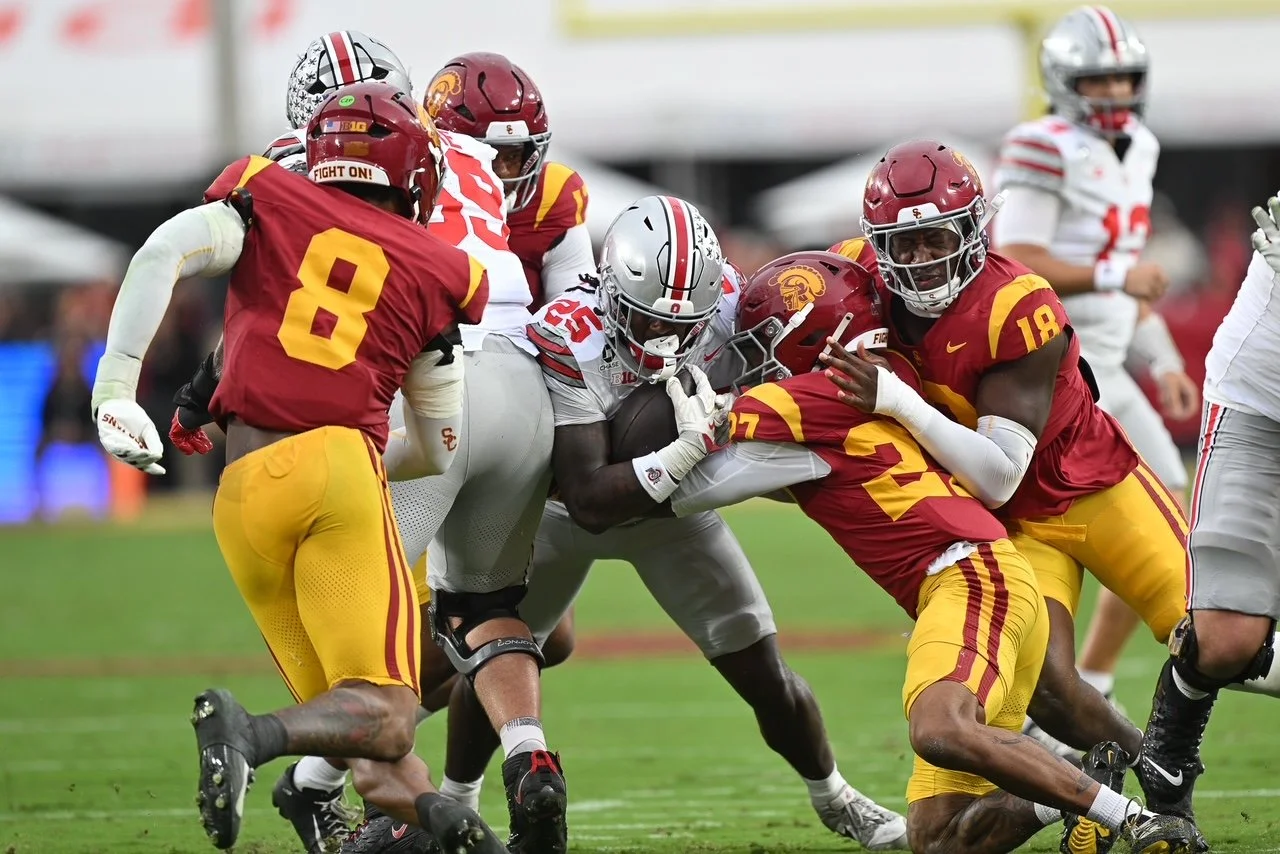
LOS ANGELES, Calif. — Ohio State entered Saturday night as the No. 2 team in the country, carrying national championship expectations and one of college football’s most talented rosters. By the time the Buckeyes walked off the field at the Los Angeles Memorial Coliseum, those expectations had taken a significant hit.
USC defeated Ohio State 30-18 in a game that exposed serious concerns about the Buckeyes’ offensive philosophy, quarterback situation and ability to compete against quality opponents down the stretch.
For head coach Ryan Day, the loss raises an uncomfortable question that has followed Ohio State in some of its biggest games: Why does a team loaded with offensive talent continue to look so hesitant when the stakes are highest?
Playing without injured starting quarterback Julian Sayin, the Buckeyes appeared more concerned with avoiding mistakes than attacking a vulnerable USC defense. Freshman Luke Fahey struggled to consistently stretch the field, while Ohio State’s offense repeatedly settled for field goals despite moving the ball effectively into the red zone.
The result was a game that looked considerably more competitive statistically than it ever felt on the scoreboard.
Ohio State outgained USC 464-338, controlled possession for nearly 40 minutes and recorded 25 first downs. Yet the Buckeyes failed to score a touchdown until the final minutes of the fourth quarter.
Those numbers tell the story of an offense capable of moving the football but unable to finish drives when it mattered most. (Ohio State)
Ohio State Played Not to Lose Rather Than to Win
Perhaps the most frustrating aspect of Saturday’s defeat was not simply that Ohio State lost, but how it approached the game offensively.
With Fahey making his first career start, some degree of caution was understandable. The freshman was stepping into a difficult road environment against a USC program desperate for a signature victory.
However, there is a difference between protecting an inexperienced quarterback and allowing that inexperience to dictate an entire offensive identity.
Ohio State appeared determined to minimize risk, relying heavily on shorter passing concepts, controlled drives and its running game rather than consistently challenging USC vertically.
That approach produced respectable yardage totals but very little offensive explosiveness.
The Buckeyes reached the scoreboard three times in the first half, but every scoring possession ended with a field goal. Even when Ohio State moved inside the USC five-yard line, the offense failed to capitalize with a touchdown.
By halftime, USC held a 20-9 advantage despite Ohio State having several opportunities to keep pace.
The Buckeyes’ inability to finish drives became especially damaging after USC extended its lead to 27-9 in the third quarter.
At that point, Ohio State needed urgency, aggression and explosive plays. Instead, the offense continued struggling to generate the type of momentum necessary to mount a comeback.
The criticism of Day and Ohio State’s offensive approach is not that every possession needed to feature a deep pass. It is that the Buckeyes rarely forced USC to defend the full capabilities of their offense.
When a program recruits at Ohio State’s level, simply protecting the football cannot become the primary objective against a talented opponent.
Eventually, the offense has to be trusted to win the game rather than merely avoid losing it.
Luke Fahey’s First Start Exposes a Major Concern
Fahey finished his first collegiate start completing 21 of 38 passes for 260 yards, one touchdown and no interceptions.
On paper, those numbers are not disastrous for a freshman making his first start on the road.
But the statistics do not fully capture Ohio State’s offensive limitations.
Fahey struggled with accuracy on deeper throws and was unable to consistently create explosive passing opportunities. His difficulties were particularly noticeable when attempting to connect with Jeremiah Smith downfield.
One missed opportunity came when Smith created separation for what could have been a long touchdown, only for an underthrown pass to prevent the completion.
The freshman also struggled to turn promising possessions into touchdowns, an issue that ultimately defined the Buckeyes’ performance.
Still, placing the entire responsibility on Fahey would be unfair.
Bo Jackson rushed for 121 yards on 21 carries, while Isaiah West contributed another 65 yards. Ohio State accumulated 204 rushing yards, demonstrating that the offense had enough success on the ground to create opportunities through play-action and more aggressive passing concepts.
Instead, the Buckeyes struggled to establish a complementary passing attack that could consistently punish USC for concentrating on the shorter areas of the field.
The absence of Sayin is clearly significant. His injury has forced Ohio State to adjust its offensive approach at one of the most difficult points of the season.
But championship contenders must find ways to adapt when injuries occur, especially when surrounded by the caliber of talent Ohio State possesses.
Fahey will need to improve quickly, but the coaching staff must also determine how to put him in positions to attack defenses rather than simply manage games. (CBS Sports)
Jeremiah Smith’s Heisman Campaign Suddenly in Jeopardy
While Ohio State’s national championship aspirations suffered a significant setback, Saturday’s loss may have also changed the direction of the Heisman Trophy race.
Jeremiah Smith entered the weekend as one of the leading candidates for college football’s most prestigious individual award.
His remarkable combination of production, explosiveness and consistency had positioned him as a legitimate threat to become one of the rare wide receivers to capture the Heisman.
Against USC, Smith finished with 10 receptions for 83 yards and one touchdown.
Those would be impressive numbers for most receivers. For Smith, however, they represented a relatively quiet performance compared with the extraordinary standard he has established.
His lone touchdown came on a one-yard reception with just 2:12 remaining, long after USC had established control of the game.
Smith also made history, recording his 40th career receiving touchdown to establish a new Big Ten record.
But the individual milestone was overshadowed by Ohio State’s offensive struggles and the implications for his Heisman campaign.
Following Saturday’s loss, Smith reportedly slipped to third in FanDuel’s Heisman odds at +340, behind Miami quarterback Darian Mensah and receiver Malachi Toney.
That movement illustrates just how quickly the award race can change, particularly when a leading candidate’s team suffers a damaging defeat late in the season. (CBS Sports)
The larger concern for Smith is how Ohio State’s quarterback situation could affect his production throughout November.
Smith entered the USC game averaging nearly 19 yards per reception, a reflection of his ability to generate explosive plays and stretch opposing defenses.
Against the Trojans, he averaged just 8.3 yards per catch.
If Ohio State continues relying primarily on shorter passes, Smith may struggle to produce the game-changing performances necessary to separate himself from other Heisman contenders.
Wide receivers already face a difficult path to winning the award, particularly when competing against quarterbacks who control the football on nearly every offensive possession.
Smith’s campaign is far from over, but the margin for error has become considerably smaller.
To regain momentum, he may need multiple dominant performances against nationally relevant opponents over the final month of the regular season.
And for that to happen, Ohio State must find a way to get him the football beyond the line of scrimmage and intermediate passing routes.
USC Exposes Problems Beyond the Quarterback Position
Although much of the attention will center on Ohio State’s offensive struggles, the Buckeyes’ defense also endured an uncharacteristically difficult evening.
USC wasted almost no time establishing its offensive intentions.
On the Trojans’ second offensive play, freshman receiver Trent Mosley broke free for a 69-yard touchdown reception from quarterback Jayden Maiava.
The explosive play immediately placed Ohio State in an unfamiliar position, forcing the Buckeyes to respond after surrendering an early touchdown.
Mosley finished with five receptions for 101 yards, while Maiava threw for 222 yards and a touchdown.
USC also received rushing touchdowns from Waymond Jordan and King Miller.
The Trojans entered the contest following a disappointing 24-7 loss to Wisconsin, making their offensive resurgence against Ohio State particularly concerning.
A defense that had been among the country’s most reliable units suddenly struggled to prevent explosive plays and maintain control of the game.
USC’s 30 points represented the most Ohio State had surrendered in a game since 2024.
The Buckeyes also committed 11 penalties for 71 yards, adding another layer of self-inflicted damage to an already difficult performance.
For a team hoping to compete for a national championship, those mistakes cannot become a recurring problem. (Ohio State Box Score)
Ohio State’s Playoff Hopes Face a Brutal November Schedule
At 6-2, Ohio State’s College Football Playoff hopes remain alive, but the Buckeyes have almost completely exhausted their margin for error.
The defeat was Ohio State’s second of the season, marking the earliest the program has suffered two losses since 2011.
More concerning is the schedule awaiting the Buckeyes over the final four weeks.
Ohio State must navigate a difficult November featuring several opponents capable of creating serious problems for a team still searching for answers offensively.
Ohio State’s remaining regular-season schedule:
November 7 — vs. Oregon: A major test against another nationally competitive program, with Ohio State needing an immediate response.
November 14 — vs. Northwestern: A potentially dangerous matchup against a disciplined Big Ten opponent.
November 21 — vs. Nebraska: Another conference test that Ohio State cannot afford to overlook.
November 28 — vs. Michigan: The annual rivalry game, carrying enormous postseason implications regardless of either team’s record.
The matchup with Oregon next Saturday could prove to be the defining game of Ohio State’s season.
A victory would provide the Buckeyes with a valuable opportunity to restore confidence and strengthen their playoff résumé.
Another defeat, however, would leave Ohio State with three losses before Thanksgiving and place its postseason future in serious jeopardy.
Even winning the remaining four games would not automatically guarantee a playoff berth. The Buckeyes would still need to compare favorably with other contenders when the selection committee evaluates their complete body of work.
At the same time, a 10-2 finish featuring victories over Oregon and Michigan would give Ohio State a compelling argument for inclusion in the 12-team field.
The problem is that the Buckeyes no longer look like a team capable of assuming victories against quality opponents.
Without Sayin, the offense must demonstrate that it can score consistently against defenses considerably stronger than the one it faced Saturday.
And with Michigan waiting at the end of November, Ohio State cannot afford to enter the final stretch still searching for an offensive identity. (Ohio State)
Ryan Day Faces Another Defining Moment
For Ryan Day, Saturday’s defeat represents more than another loss in the standings.
It raises questions about Ohio State’s ability to adjust when its original game plan becomes ineffective.
The Buckeyes entered the season with legitimate national championship expectations, an elite receiving corps and a defense capable of competing with almost anyone in college football.
Yet against USC, Ohio State looked uncomfortable playing from behind and unwilling to consistently take the offensive risks necessary to change the game.
That is particularly troubling considering the talent available.
Smith remains one of the most dangerous offensive players in the country. Jackson has demonstrated that he can provide consistent production in the running game. Chris Henry Jr. and the rest of the receiving corps offer additional playmaking ability.
Ohio State does not lack weapons.
What it lacked Saturday was the ability to use those weapons decisively when the game demanded it.
Day now faces the challenge of rebuilding an offense around an inexperienced quarterback while simultaneously preparing for one of the most difficult stretches of the season.
There is little time for gradual improvement.
Oregon arrives in Columbus next weekend, and another performance defined by conservative play-calling, missed opportunities and red-zone failures could effectively end Ohio State’s realistic national championship ambitions.
A Season That Once Looked Promising Is Suddenly on the Brink
Perhaps the most alarming takeaway from Saturday’s defeat is how quickly Ohio State’s outlook has changed.
Only weeks ago, the Buckeyes appeared positioned to compete for a Big Ten championship, earn a favorable playoff seed and potentially watch Smith capture the Heisman Trophy.
Now, all three possibilities face significant uncertainty.
The loss to USC did not mathematically eliminate Ohio State from postseason contention, nor did it end Smith’s Heisman campaign.
But it dramatically changed the stakes of every remaining game.
Ohio State can no longer rely on its reputation, recruiting rankings or early-season accomplishments to carry it through November.
The Buckeyes must prove they can defeat quality opponents with the quarterback and personnel currently available.
That will require more aggressive offensive execution, improved defensive discipline and a willingness to trust their playmakers in critical situations.
Above all, Ohio State must abandon the hesitant approach that contributed to Saturday’s defeat.
There is a difference between playing intelligently and playing scared.
Against USC, the Buckeyes too often appeared to be doing the latter.
And with Oregon, Northwestern, Nebraska and Michigan still waiting, Ohio State’s season may ultimately depend on whether Day and his team can rediscover the mentality necessary to play to win rather than simply hoping not to lose.