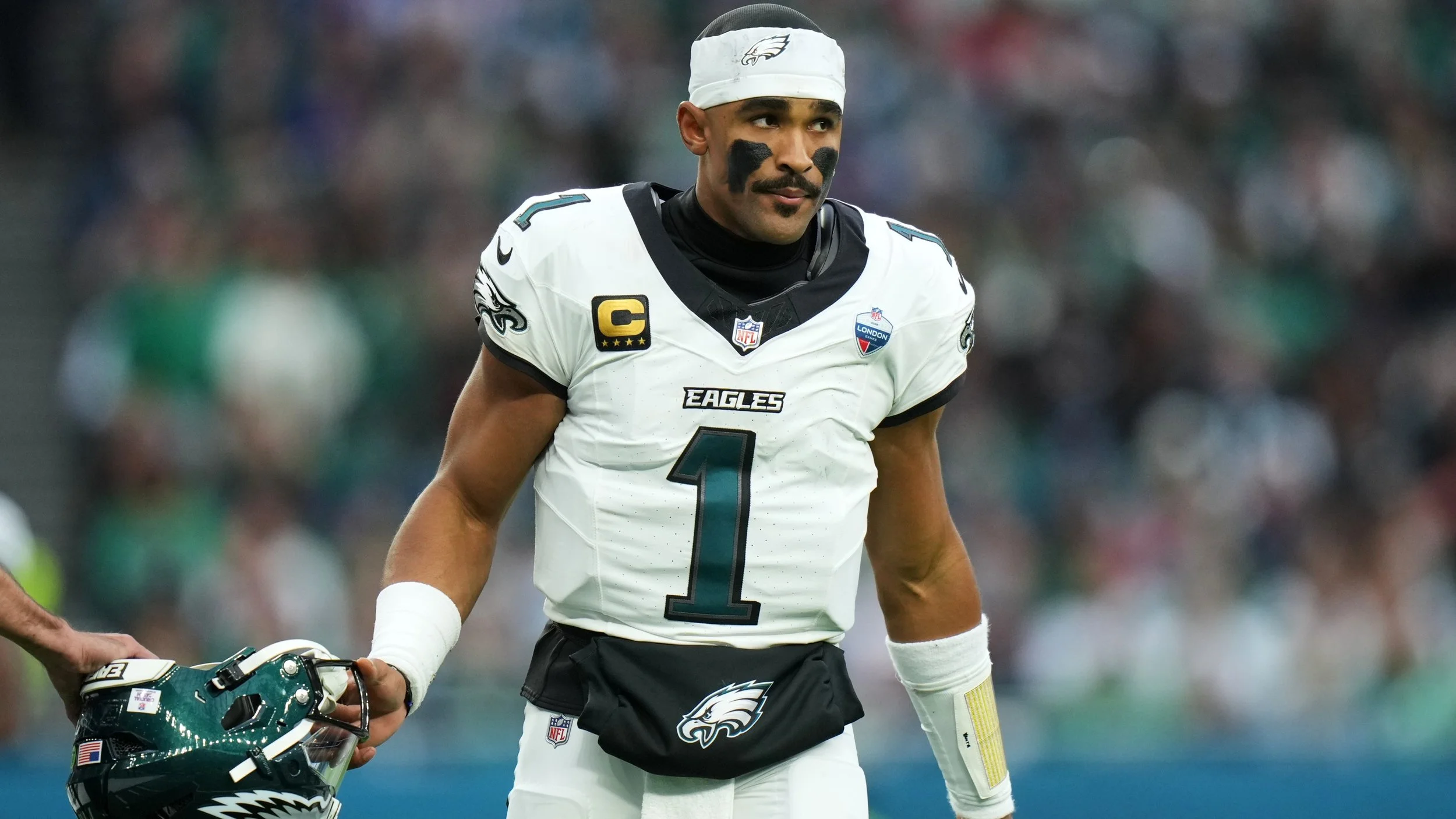
The Philadelphia Eagles are facing a situation far more concerning than their early-season struggles, as franchise quarterback Jalen Hurts has been diagnosed with a blood clot in his calf, raising questions about his immediate availability and the potential implications for his long-term playing career.
The Eagles announced Thursday that Hurts would miss Sunday’s matchup against the Carolina Panthers after a follow-up ultrasound revealed movement in a previously discovered superficial blood clot. While the organization has not established a timeline for his return, the situation introduces medical concerns that extend well beyond a typical football injury. (NFL.com)
The issue reportedly began during Philadelphia’s October 4 matchup against the Los Angeles Rams, when Hurts was struck in the calf by an opposing player’s cleat. He initially continued practicing before seeking treatment on October 8. An ultrasound conducted following the team’s arrival in London revealed the clot, although medical personnel initially determined that Hurts could safely participate in the Eagles’ game against Jacksonville.
Hurts played the entire contest against the Jaguars, completing 21 of 40 passes for 220 yards and a touchdown in Philadelphia’s 19-17 loss. However, additional testing Wednesday revealed that the clot had moved, prompting the organization to immediately rule him out against Carolina. (Reuters)
Although the clot has been classified as superficial, meaning it developed in a vein closer to the skin rather than a deep vein, medical professionals have emphasized that such conditions still require careful monitoring. In certain circumstances, superficial clots can extend into deeper veins, potentially creating more dangerous complications.
One of the biggest concerns surrounding Hurts’ recovery involves the possibility of blood-thinning medication. Depending on the clot’s location, size and progression, doctors may prescribe anticoagulants to reduce the risk of further clotting. Such treatment can complicate a professional athlete’s return, particularly in a physical sport like football, where repeated collisions create an elevated risk of serious bleeding.
Medical experts have indicated that recovery timelines can vary significantly, with some superficial clots resolving relatively quickly while others require extended treatment and monitoring. (USA Today)
For Hurts, whose playing style relies heavily on mobility, physicality and the ability to absorb contact, the uncertainty surrounding his treatment creates an especially difficult situation. Even if his symptoms improve, medical clearance for full-contact football could depend on factors beyond his ability to run, throw or practice without discomfort.
The diagnosis does not currently suggest that Hurts’ career is in immediate jeopardy. However, complications involving blood clots, particularly if they recur or require prolonged anticoagulant treatment, could potentially threaten an athlete’s ability to safely continue participating in professional sports.
It is an unsettling development for a quarterback who has established himself among the NFL’s most accomplished players. The 28-year-old has already led Philadelphia to two Super Bowl appearances, captured Super Bowl LIX MVP honors and earned three Pro Bowl selections.
His absence also comes at a difficult time for the Eagles, who have dropped three consecutive games after opening the season 2-0. Philadelphia will turn to backup quarterback Tanner McKee against Carolina, with upcoming divisional matchups against Dallas, Washington and the New York Giants looming on the schedule. (CBS Sports)
For Philadelphia, the immediate challenge will be keeping its season from slipping further away without its franchise quarterback. But the organization’s longer-term concerns are considerably more important.
Hurts has built his career around resilience, leadership and his ability to perform under pressure. This time, however, the circumstances are different. A blood clot is not an injury that can simply be played through, and the consequences of returning prematurely could extend far beyond the football field.
There remains reason for optimism, particularly given the superficial nature of the clot and the absence of any reported deep-vein complications. Nevertheless, until doctors determine the appropriate treatment and establish a clearer recovery timeline, uncertainty will surround one of the NFL’s most recognizable quarterbacks.
For now, the Eagles’ priority is no longer how quickly Hurts can return to the field, but ensuring that when he does, his health and future are not being placed at unnecessary risk.