Remembering the Legendary Mike Ditka: The Heart of Chicago Football
Few figures in NFL history have left their mark on the game quite like Mike Ditka. From his groundbreaking years as a tight end to his fiery leadership on the sidelines, Ditka built a football legacy defined by toughness, competitiveness, and an unmistakable personality.
Best remembered for leading the Chicago Bears to victory in Super Bowl XX, Ditka’s influence extends well beyond one championship season. His playing career helped transform the tight end position into a legitimate offensive weapon, while his coaching career produced one of the most recognizable and dominant teams in NFL history.
For generations of football fans, particularly those in Chicago, Ditka became more than a successful player and coach. He became a symbol of the city’s football identity. (Chicago Bears)
From Pennsylvania Roots to College Football Stardom
Born October 18, 1939, in Carnegie, Pennsylvania, Michael Keller Ditka grew up in the blue-collar environment of western Pennsylvania, where football was deeply embedded in the local culture.
Ditka attended Aliquippa High School before continuing his football career at the University of Pittsburgh. Playing for the Panthers from 1958 through 1960, he developed a reputation as a physical, versatile player who could contribute both as a receiver and a blocker.
At a time when tight ends were primarily expected to serve as additional offensive linemen, Ditka demonstrated that the position could offer considerably more.
His outstanding college career earned him consensus All-American recognition in 1960, establishing him as one of the nation’s premier prospects. Decades later, his accomplishments would be recognized with induction into the College Football Hall of Fame. (Pro Football Hall of Fame)
Revolutionizing the Tight End Position in Chicago
The Chicago Bears selected Ditka with the fifth overall pick in the 1961 NFL Draft, beginning a professional playing career that would ultimately span 12 seasons.
His impact was immediate.
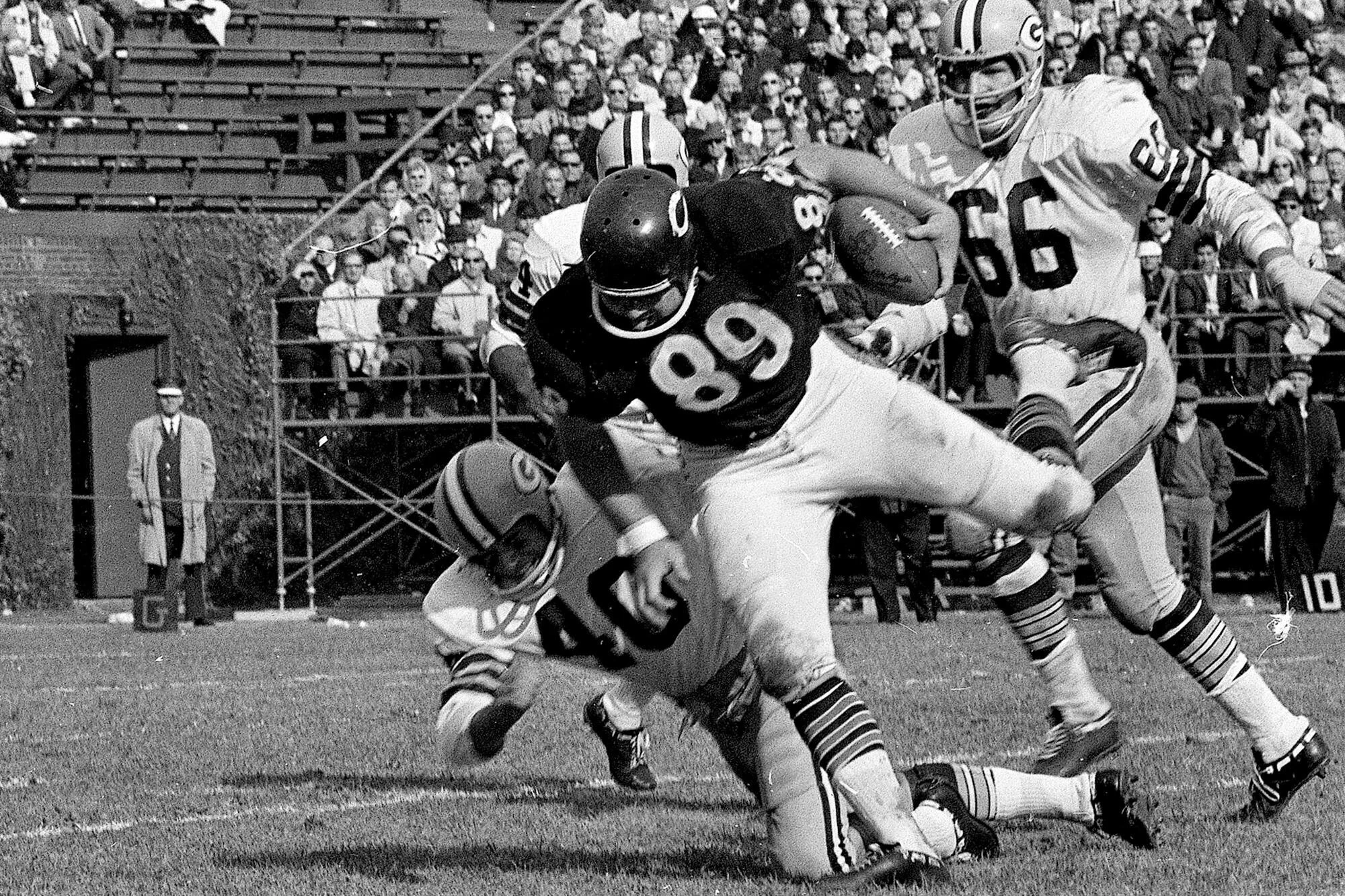
During his rookie season, Ditka caught 56 passes for 1,076 yards and 12 touchdowns, extraordinary production for a tight end in an era dominated by rushing attacks. His performance earned him NFL Rookie of the Year honors and helped establish a new standard for the position. (Pro Football Hall of Fame)
Ditka combined the physicality of a traditional tight end with the receiving ability of a wideout, forcing opposing defenses to account for him in ways they rarely had before.
His success continued throughout the early 1960s. Ditka earned five consecutive Pro Bowl selections from 1961 through 1965 and received first-team All-Pro recognition twice.
In 1963, he helped Chicago capture the NFL championship under legendary head coach George Halas. The Bears defeated the New York Giants 14-10, giving Ditka his first professional championship. (Pro Football Hall of Fame)
Ditka remained with Chicago through the 1966 season before spending two years with the Philadelphia Eagles. He then joined the Dallas Cowboys in 1969, where he would add another championship to his résumé.
As a member of the Cowboys, Ditka helped Dallas defeat the Miami Dolphins 24-3 in Super Bowl VI. He caught a touchdown pass in the victory, becoming a champion once again before retiring following the 1972 season.
By the end of his playing career, Ditka had accumulated 427 receptions, 5,812 receiving yards, and 43 touchdowns.
His contributions were formally recognized in 1988 when he was inducted into the Pro Football Hall of Fame, becoming the first player inducted primarily for his accomplishments as a tight end. (Pro Football Hall of Fame)
Learning the Coaching Profession Under Tom Landry
Following his retirement as a player, Ditka immediately transitioned into coaching, joining the Dallas Cowboys staff under Hall of Fame head coach Tom Landry in 1973.
The move gave Ditka an opportunity to study the game from an entirely different perspective. Landry was widely respected for his disciplined approach, preparation, and innovative football strategies, providing an invaluable learning environment for the former tight end.
Ditka spent nine seasons with Dallas as an assistant, working with receivers and special teams while helping the Cowboys remain among the NFL’s premier organizations.
During his tenure, Dallas made three Super Bowl appearances and defeated the Denver Broncos 27-10 in Super Bowl XII following the 1977 season.
That championship gave Ditka another Super Bowl ring, this time as an assistant coach.
His years in Dallas helped shape the demanding coaching philosophy that would eventually become his trademark. While Landry was known for his measured demeanor, Ditka brought considerably more emotion to the sidelines. Nevertheless, both men shared an uncompromising expectation of preparation, discipline, and winning.
By the early 1980s, Ditka was ready for an opportunity to lead his own team. (NFL.com)
Returning to Chicago: Building a Championship Culture
In 1982, Ditka returned to the organization where his professional career began, accepting the head coaching position with the Chicago Bears.
The franchise had struggled to recapture the success it experienced under George Halas, having gone nearly two decades without another NFL championship.
Ditka inherited a roster featuring several talented players, including legendary running back Walter Payton, but Chicago lacked the consistency necessary to compete with the league’s elite.
His arrival brought an immediate change in expectations.
Ditka demanded physical football, accountability, and a relentless commitment to winning. His confrontational coaching style was not universally embraced, but it quickly became part of the team’s identity.
After finishing 3-6 during the strike-shortened 1982 season, Chicago gradually developed into a serious contender.
By 1984, the Bears had captured the NFC Central division title and advanced to the NFC Championship Game, where they fell to the eventual Super Bowl champion San Francisco 49ers.
Although Chicago’s season ended one victory short of the Super Bowl, the foundation had been established for something considerably greater. (Chicago Bears)
The 1985 Chicago Bears: One of Football’s Greatest Teams
The defining achievement of Ditka’s coaching career came during the 1985 NFL season.
Under his leadership, Chicago assembled one of the most dominant teams professional football had ever witnessed.
The Bears finished the regular season with a remarkable 15-1 record, combining a punishing rushing attack with a historically dominant defense coordinated by Buddy Ryan.
Led offensively by Walter Payton and quarterback Jim McMahon, Chicago featured a physical, aggressive approach that perfectly reflected its head coach.
Defensively, the Bears possessed an extraordinary collection of talent, including Mike Singletary, Richard Dent, Dan Hampton, Steve McMichael, and William “Refrigerator” Perry.
Ryan’s famous 46 defense overwhelmed opposing offenses through relentless pressure, producing one of the most intimidating defensive units in league history. (Pro Football Hall of Fame)
Chicago’s only regular-season loss came against Dan Marino and the Miami Dolphins in a 38-24 Monday Night Football defeat.
Outside of that setback, few opponents could match the Bears’ physicality or talent.
The postseason proved even more impressive.
Chicago opened its playoff run with a 21-0 shutout of the New York Giants before defeating the Los Angeles Rams 24-0 in the NFC Championship Game.
The Bears then completed their championship campaign with a commanding 46-10 victory over the New England Patriots in Super Bowl XX.
The 36-point margin of victory was the largest in Super Bowl history at the time, cementing Chicago’s place among the greatest single-season teams the NFL had ever produced. (NFL.com)
Ditka earned NFL Coach of the Year honors for his leadership, while the 1985 Bears became a cultural phenomenon whose popularity extended far beyond football.
The team’s personalities, celebrations, and famous “Super Bowl Shuffle” helped create an identity that remains recognizable more than four decades later.
For Ditka, the championship represented the culmination of everything he had worked toward since returning to Chicago.
He had now won championships with the Bears as both a player and head coach. (Chicago Bears)
Sustaining Success and His Final Years in Chicago
Although the Bears never returned to the Super Bowl under Ditka, the franchise remained among the NFC’s strongest teams throughout much of the late 1980s.
Chicago captured five consecutive NFC Central titles from 1984 through 1988, a remarkable stretch that demonstrated the program’s consistency beyond its historic championship season.
Ditka’s leadership helped maintain a winning culture despite injuries, roster changes, and the challenges of remaining competitive in an increasingly demanding conference.
In 1988, he faced a serious personal health scare when he suffered a heart attack during the season.
Despite the setback, Ditka returned to the sidelines remarkably quickly and helped guide Chicago to a 12-4 record and another NFC Championship Game appearance.
His efforts earned him a second NFL Coach of the Year award.
However, the Bears gradually began to decline in the early 1990s. After consecutive losing seasons in 1992, Chicago parted ways with Ditka.
He finished his 11-season tenure with the Bears with a 106-62 regular-season record, along with six division championships and seven playoff appearances.
His departure marked the conclusion of one of the most successful coaching periods in franchise history. (Pro Football Reference)
A Final Coaching Opportunity in New Orleans
After several years away from coaching, Ditka returned to the NFL in 1997 when he became head coach of the New Orleans Saints.
The move represented an opportunity to rebuild a franchise that had struggled to establish consistent success.
However, Ditka’s tenure in New Orleans proved considerably more difficult than his years in Chicago.
The Saints finished 6-10 in each of his first two seasons before falling to 3-13 in 1999.
One of the most memorable decisions of his New Orleans tenure came during the 1999 NFL Draft, when the Saints traded their entire collection of picks that year, along with additional selections, to Washington to acquire running back Ricky Williams.
The aggressive move generated national attention but ultimately failed to produce the immediate turnaround Ditka envisioned.
Following the 1999 season, New Orleans dismissed him, bringing his NFL head coaching career to an end.
Across 14 seasons with Chicago and New Orleans, Ditka compiled a 121-95 regular-season record.
While his final coaching chapter lacked the success of his earlier years, it did little to diminish the significance of his accomplishments in Chicago. (Pro Football Reference)
Beyond Football: The Personality Behind “Iron Mike”
Ditka’s influence extended well beyond the football field.
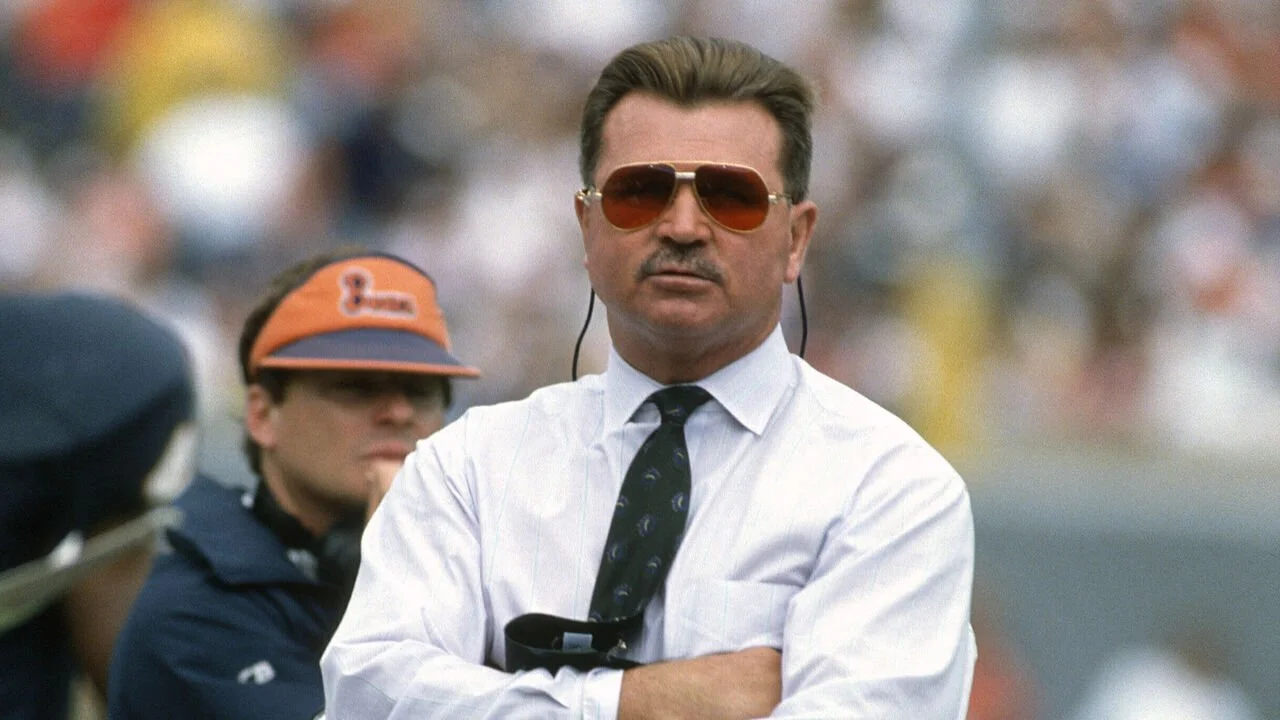
His trademark mustache, dark sunglasses, intense expressions, and outspoken personality made him one of the NFL’s most recognizable public figures.
Affectionately known as “Iron Mike” and “Da Coach,” he became a symbol of Chicago sports culture, with his personality inspiring the famous “Da Bears” sketches on Saturday Night Live.
Following his coaching career, Ditka remained involved with professional football through broadcasting, working as an analyst for major networks, including ESPN.
He also pursued business ventures, including restaurants and branded merchandise, while making appearances in television shows, commercials, and films.
Beyond his public persona, Ditka advocated for improved health care and pension benefits for retired NFL players, particularly those from earlier generations who faced financial and medical difficulties after leaving football.
His outspoken nature occasionally generated controversy, but it also contributed to the authenticity that made him such a memorable figure.
Whether celebrating a victory, criticizing a poor performance, or discussing the state of professional football, Ditka rarely left anyone wondering where he stood. (Reuters)
Remembering Mike Ditka: A Legacy That Transcends Generations
On October 9, 2026, the football world lost one of its most influential personalities when Mike Ditka died at the age of 86, just nine days before his 87th birthday.
His family confirmed his passing in a statement remembering him not only as a Hall of Fame player and championship-winning coach, but as a husband, father, grandfather, and friend. A cause of death was not immediately disclosed. (Reuters)
Ditka’s career remains remarkable for its accomplishments across multiple generations of professional football.
As a player, he helped redefine the tight end position, demonstrating that physical blocking and elite receiving production could coexist in the same offensive role.
As an assistant coach, he contributed to the success of Tom Landry’s Dallas Cowboys.
As a head coach, he guided the Chicago Bears to one of the most dominant championships in NFL history.
He also achieved the rare distinction of winning Super Bowls as a player, assistant coach, and head coach, an accomplishment shared with fellow Hall of Famer Tom Flores. (Pro Football Hall of Fame)
His honors include induction into both the College Football Hall of Fame in 1986 and the Pro Football Hall of Fame in 1988, five Pro Bowl selections, two first-team All-Pro selections, and two NFL Coach of the Year awards.
Yet statistics and championships alone cannot fully explain Ditka’s place in football history.
His greatest contribution may have been the identity he helped establish, particularly in Chicago, where toughness, accountability, and pride became inseparable from the Bears teams he represented.
More than 40 years after the 1985 championship, Chicago fans still celebrate that team as the standard against which every subsequent Bears roster is measured.
And at the center of those memories stands Ditka, a man whose passion for football helped turn an extraordinary championship season into an enduring piece of American sports culture.
Mike Ditka’s legacy will not be remembered solely through the championships he won, but through the generations of players, coaches, and fans who came to associate his name with the very essence of Chicago Bears football.