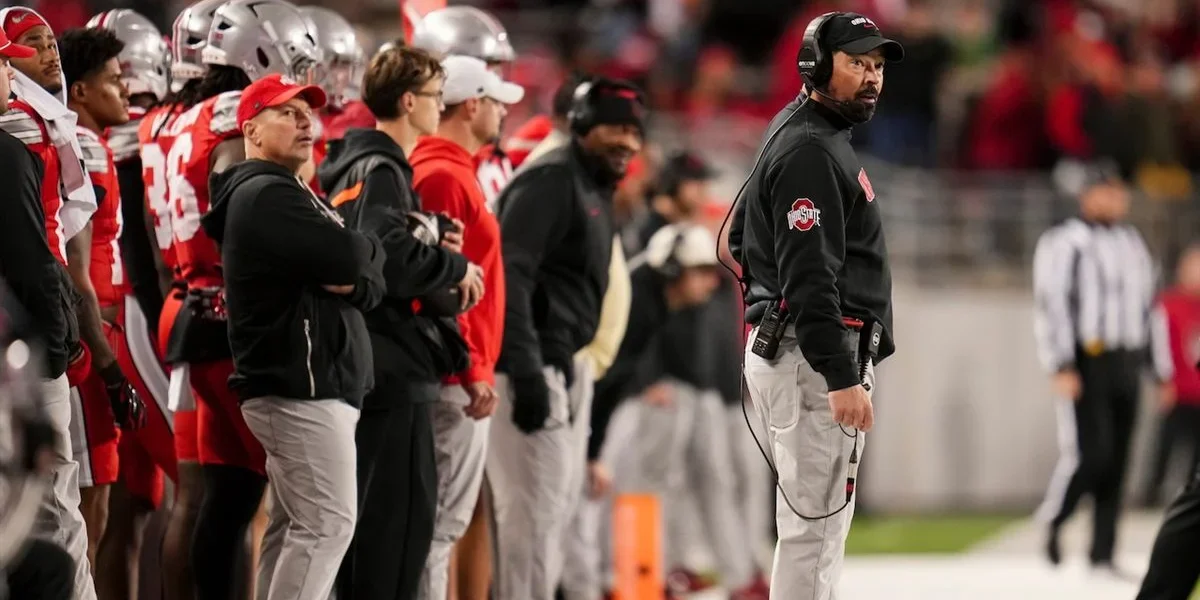
COLUMBUS, Ohio — Ohio State has made its first significant coaching change of a disappointing 2026 season, firing special teams coordinator Robby Discher following consecutive losses to USC and Oregon. However, the decision could represent the beginning of a much larger restructuring within Ryan Day’s coaching staff as the Buckeyes attempt to salvage a season that has fallen well short of expectations.
The Buckeyes entered the season ranked No. 1 nationally with championship aspirations. Nine games later, Ohio State sits at 6-3 overall and 4-2 in Big Ten play, with its College Football Playoff hopes in serious jeopardy. The program’s struggles have intensified scrutiny of Day and his coordinators, particularly offensive coordinator Arthur Smith and defensive coordinator Matt Patricia.
While Day’s substantial contract makes a head coaching change financially complicated, the same level of security does not necessarily extend to his assistants. With Discher already dismissed and reports suggesting additional changes could follow, Ohio State may be approaching one of its most significant coaching staff overhauls in recent memory. (Reuters, Heavy)
Special Teams Struggles Lead to Discher’s Dismissal
Discher’s departure comes less than a full season after he was hired from Illinois in February to address Ohio State’s longstanding special teams inconsistencies.
The final breaking point came during Saturday’s 41-28 loss to Oregon at Ohio Stadium. With Ohio State leading 14-3 in the second quarter, the Ducks successfully executed a fake punt on fourth-and-9 from their own 31-yard line, gaining 30 yards and extending a possession that ultimately helped reverse the game’s momentum.
Oregon went on to score 38 unanswered points, turning what initially appeared to be a promising afternoon for the Buckeyes into another damaging defeat.
The problems extended beyond the Oregon game. Against USC on October 31, Ohio State surrendered a 44-yard punt return and committed three special teams penalties in a 30-18 loss. Earlier in the season, a missed 45-yard field goal against Texas contributed to a narrow 24-23 defeat.
Ohio State ranks 102nd nationally in special teams efficiency, a particularly concerning statistic for a program with the resources and talent available in Columbus.
Discher’s firing also represents a notable departure from Day’s previous approach to personnel decisions. It marks the first time during his eight-year tenure as head coach that he has dismissed an assistant during the regular season. (Associated Press, FootballScoop)
Arthur Smith Faces Questions About Ohio State’s Offensive Identity
Although special teams produced some of Ohio State’s most visible mistakes, the offense has arguably generated the most frustration throughout the Buckeyes’ recent struggles.
Arthur Smith arrived in Columbus with an extensive NFL résumé, having served as head coach of the Atlanta Falcons and offensive coordinator for the Tennessee Titans and Pittsburgh Steelers. His hiring was intended to provide Ohio State with an experienced offensive strategist capable of maximizing its talented personnel.
Instead, the Buckeyes have struggled to establish a consistent offensive identity against stronger competition.
The absence of starting quarterback Julian Sayin has undoubtedly complicated matters, forcing backup Luke Fahey into a difficult position. However, injuries alone cannot explain every shortcoming, particularly the questionable play-calling, inconsistent rushing attack and inability to consistently involve star wide receiver Jeremiah Smith.
During the Oregon loss, Ohio State went nearly 33 minutes of game time without targeting Jeremiah Smith, an especially troubling development considering his importance to the offense.
For a program accustomed to explosive passing attacks and dynamic offensive production, the current approach has appeared increasingly conservative. Too often, Ohio State has seemingly prioritized avoiding mistakes rather than aggressively exploiting opposing defenses.
Smith’s NFL experience was supposed to provide stability, but his first season has raised questions about whether his offensive philosophy is the right fit for Ohio State’s personnel and expectations.
With the Buckeyes struggling to generate consistent production against ranked opponents, Smith could become one of the most closely evaluated members of Day’s staff when the season concludes. (Ohio State Athletics, Land-Grant Holy Land)
Matt Patricia’s Defense Has Become Another Growing Concern
Defensive coordinator Matt Patricia is facing similar scrutiny as Ohio State’s defense has struggled to maintain its early-season performance.
Patricia, another former NFL head coach, was retained after helping oversee a successful defensive unit in 2025. However, the departures of several important defensive contributors have exposed weaknesses that opposing offenses have increasingly exploited.
The most concerning development has been the defense’s performance over the past two games.
Against USC and Oregon, Ohio State struggled to consistently pressure opposing quarterbacks, prevent explosive plays and make critical stops when momentum began shifting.
The Oregon defeat was particularly damaging. After the Buckeyes established a 14-0 lead, the defense was unable to contain the Ducks’ offense as Oregon took control of the game.
Patricia’s defensive approach has also drawn criticism for its conservative tendencies, including three-man pass rushes that have occasionally provided opposing quarterbacks with additional time to attack the secondary.
The defensive coordinator is reportedly earning $3.75 million this season, making him the highest-paid assistant coach in college football. At that level of compensation, expectations extend beyond producing a respectable defense against lesser opponents. Ohio State expects its defense to perform at a championship level against elite competition.
Patricia’s future remains uncertain, and no dismissal has been announced. Nevertheless, his unit’s recent regression makes him another potential candidate for evaluation if Ohio State decides a broader coaching overhaul is necessary. (Heavy, Land-Grant Holy Land)
Ryan Day’s Massive Contract Complicates Any Potential Head Coaching Change
Despite growing frustration surrounding Ohio State’s performance, removing Ryan Day would present the university with a significantly greater financial challenge than replacing his coordinators.
Day agreed to a contract extension in February 2025 that reportedly pays him approximately $12.5 million annually through 2031, placing him among the highest-paid coaches in college football.
Although his annual compensation is frequently discussed in the $13 million range, the more important consideration is the substantial financial obligation Ohio State could face if it terminated his contract without cause.
His buyout would depend on the specific contractual terms and any applicable offsets, but the remaining guaranteed compensation could create a financial commitment worth tens of millions of dollars.
That reality makes retaining Day while restructuring the coaching staff a more practical option than immediately pursuing a complete change in leadership.
However, Day’s contract should not be confused with unconditional job security. Ohio State remains one of college football’s most demanding programs, and financial considerations do not eliminate the pressure created by disappointing results.
If the Buckeyes continue struggling, questions surrounding Day’s leadership will only intensify. For now, replacing assistants could provide the university with an opportunity to pursue meaningful changes without absorbing the potentially enormous expense of dismissing its head coach. (Heavy)
Could Ohio State Be Preparing to Clean House?
Discher’s dismissal has raised an important question: Is Ohio State making an isolated coaching change, or is the university preparing for a much larger restructuring?
According to reporting attributed to The Athletic, multiple sources around the program believe Discher’s departure could be the first of several changes to Day’s staff. Additional decisions, however, may not arrive until after the regular season.
That distinction is important. Ohio State has not announced plans to dismiss Smith or Patricia, and neither coordinator’s departure should be treated as inevitable.
Still, the possibility of substantial turnover reflects the seriousness of the Buckeyes’ current situation.
Day assembled a staff featuring experienced former NFL head coaches with the expectation that their knowledge would translate into consistent, championship-caliber performances. Instead, Ohio State has struggled across all three phases of the game.
A comprehensive coaching overhaul could allow Day to reevaluate the program’s offensive philosophy, defensive structure and overall player development.
It could also represent an acknowledgment that the current coaching arrangement has failed to meet expectations.
For Ohio State, the decision is about more than simply replacing underperforming assistants. The university must determine whether its current coaching philosophy remains capable of competing with the nation’s best programs. (Heavy)
Final Stretch Could Determine the Future of Ohio State’s Coaching Staff
Ohio State’s remaining schedule provides little opportunity for the Buckeyes to escape scrutiny.
The Buckeyes host Northwestern on November 14 before traveling to Nebraska and eventually closing the regular season against Michigan.
Each matchup carries significant implications for the program’s postseason aspirations and the future of its coaching staff.
Another disappointing performance could strengthen the argument for additional personnel changes, while a strong finish might provide Day with evidence that the program can recover without a complete restructuring.
The upcoming Michigan game will carry particular importance. Rivalry results have historically played an enormous role in evaluating Ohio State head coaches, and another defeat would only increase the pressure surrounding Day’s leadership.
A Defining Moment for Ryan Day and Ohio State
Ohio State’s decision to fire Robby Discher sends a clear message that disappointing results will carry consequences.
However, special teams represent only one component of a program that has struggled to meet expectations throughout the 2026 season.
Arthur Smith’s offensive inconsistencies and Matt Patricia’s defensive regression have created legitimate questions about whether the Buckeyes possess the coaching structure necessary to return to championship contention.
Ryan Day remains the central figure in that discussion. His substantial contract makes a head coaching change financially difficult, but it also places greater responsibility on him to identify problems and implement solutions.
If Ohio State ultimately decides to retain Day while replacing multiple coordinators, the university would effectively be giving its head coach another opportunity to rebuild the program around a new staff.
That approach may be the most financially realistic option, but it would also increase expectations for immediate improvement.
Discher’s firing could prove to be a relatively minor adjustment in an otherwise disappointing season. It could also become the first step toward a sweeping transformation of Ohio State football.
Either way, the Buckeyes have reached a point where maintaining the status quo is becoming increasingly difficult to justify.