Remembering Bob Pettit: Honoring the Life and Legacy of an NBA Pioneer
Bob Pettit passed away today, September 24th, 2026 at the age of 93. He left behind a legacy stretching back to the NBA’s formative years. Before the modern power forward, before the enormous television contracts and before professional basketball became the worldwide spectacle it is today, Pettit was setting standards that future generations would chase.
Bob Pettit wasn’t simply one of the NBA’s earliest superstars. He was one of the players who helped build the foundation for the NBA we know today. (NBA.com)
Long before the NBA became a global league filled with versatile big men, massive television audiences, and multimillion-dollar superstars, Bob Pettit was helping establish what greatness looked like.
Born in Baton Rouge, Louisiana, in 1932, Pettit’s path to basketball immortality was far from guaranteed. He was cut from his high school varsity team as a sophomore before developing into a state champion and eventually becoming a star at LSU. With the Tigers, Pettit led the SEC in scoring in each of his three varsity seasons and helped LSU reach its first Final Four in 1953. His No. 50 became the first jersey number retired in any sport at LSU. (LSU Sports)
Selected second overall by the Milwaukee Hawks in the 1954 NBA Draft, Pettit quickly proved that his success would translate to the professional level. He averaged 20.4 points and 13.8 rebounds as a rookie, earning the 1955 NBA Rookie of the Year award. One year later, Pettit became the recipient of the NBA’s first regular-season Most Valuable Player award. He would capture the honor again in 1959. (NBA.com)
Pettit’s greatest team accomplishment came in 1958 with the St. Louis Hawks. Facing Bill Russell and the powerhouse Boston Celtics in the NBA Finals, Pettit delivered one of the defining performances of his career. He scored 50 points in Game 6, leading St. Louis to a 110-109 victory that secured the NBA championship. It remains the only championship in Hawks franchise history. (NBA.com)
By the time Pettit retired in 1965, his résumé was remarkable: two NBA MVP awards, 11 All-Star selections in 11 seasons, 10 All-NBA First Team selections, four All-Star Game MVP awards, two scoring titles and an NBA championship. He finished with 20,880 points and 12,849 rebounds while averaging an extraordinary 26.4 points and 16.2 rebounds per game. Most significantly, Pettit became the first player in NBA history to surpass 20,000 career points. (NBA.com)
But Pettit’s importance goes beyond statistics.
At 6-foot-9, Pettit helped create the blueprint for what would eventually become the modern power forward. At a time when big men were generally expected to remain near the basket, Pettit could face the rim and score from farther away while still dominating the glass. His combination of shooting, scoring, physical rebounding and mobility was unusual for a player his size. The Basketball Hall of Fame describes him as one of the first big men to play facing the basket, while the NBA has credited him with helping define the modern power-forward position. (The Naismith Basketball Hall of Fame)
In many ways, the versatility expected from today’s NBA forwards can be traced back to players like Pettit. The game has changed dramatically, but the idea of a big man being more than simply an interior player was something Pettit demonstrated decades before it became commonplace.
His life after basketball was impressive in its own right. Pettit returned to Louisiana and built a lengthy career in banking, investing and financial consulting. During his playing career, he had even worked in his family’s real estate and insurance business during NBA offseasons—a reminder of just how different life was for professional athletes during the league’s early years. He eventually co-founded financial consulting company Equitas Capital Investors and remained in the financial world for decades. (louisianalife.com)
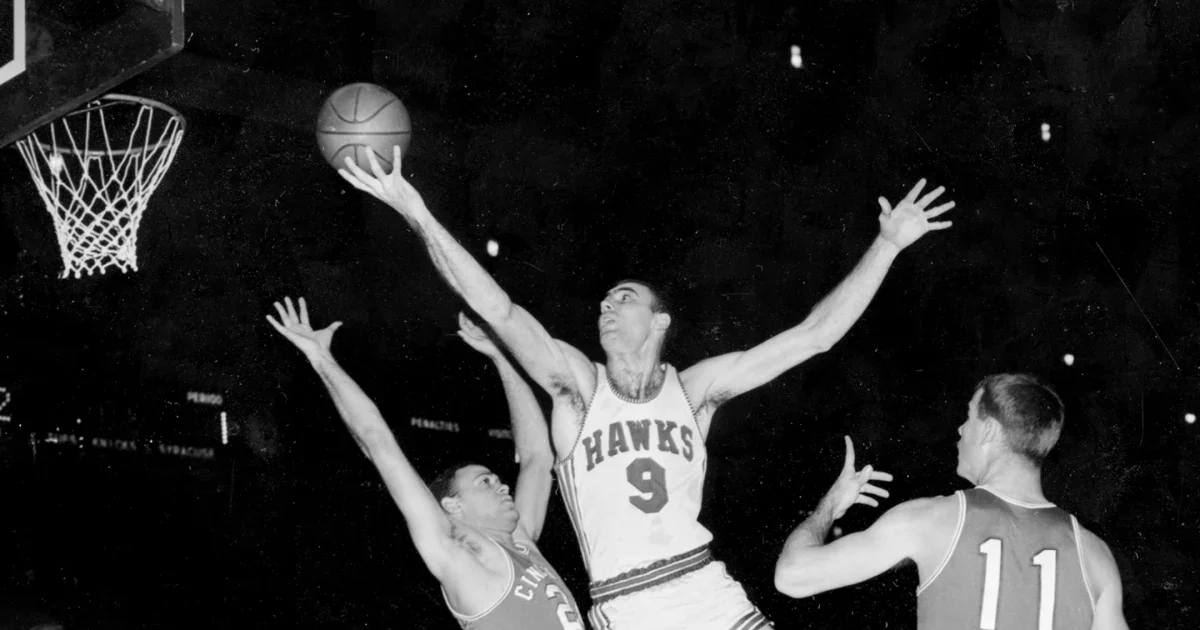
Basketball, however, never disappeared from his life. Pettit remained closely connected to LSU and was honored with a statue outside the school’s basketball arena. His No. 9 was also retired by the Hawks, and he was selected to the NBA’s 25th, 35th, 50th and 75th Anniversary Teams. (NBA.com)
Bob Pettit may be gone, but his impact on basketball will live on for generations, forever remembered as a champion, a pioneer, and one of the NBA’s first true legends.