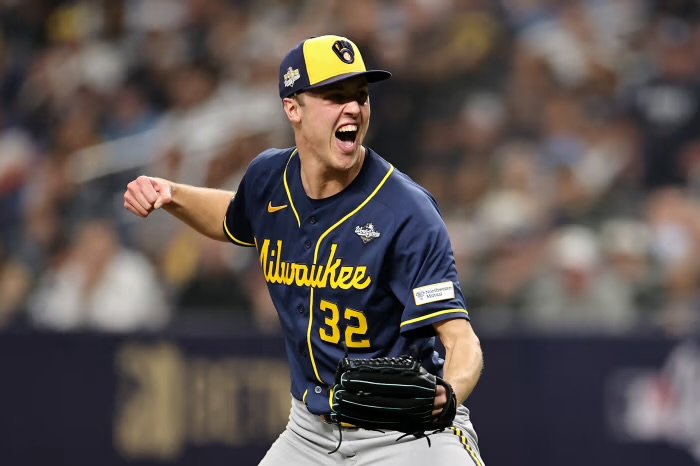
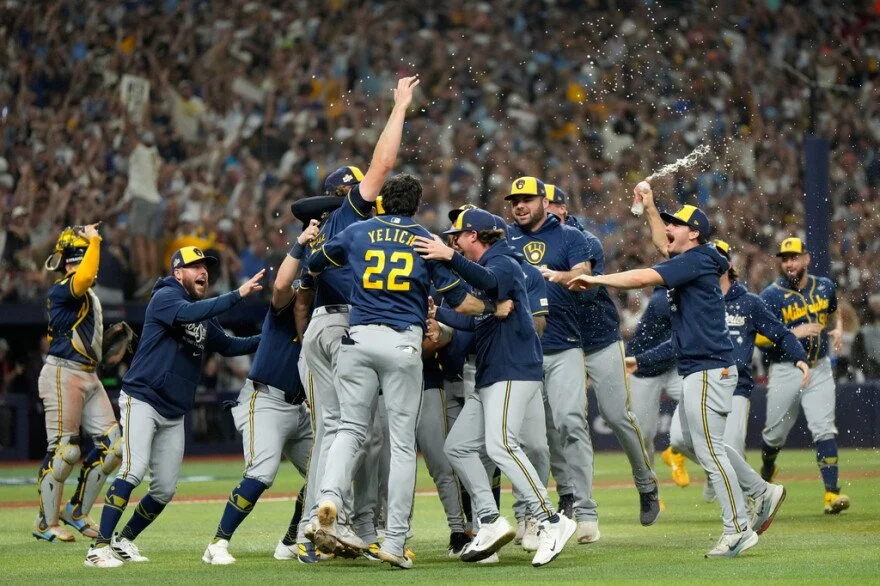
ST. PETERSBURG, Fla. — For the first time in franchise history, the Milwaukee Brewers are champions of the baseball world.
After 57 years in Milwaukee, decades of postseason disappointment, and a championship drought that stretched across generations, the Brewers finally reached the pinnacle of Major League Baseball on Wednesday night, defeating the Tampa Bay Rays 4-1 in Game 5 of the World Series at Tropicana Field.
Milwaukee captured the best-of-seven series four games to one, completing one of the most impressive seasons in franchise history and delivering the city’s first World Series championship since the Milwaukee Braves won it all in 1957.
Behind another dominant pitching performance from Jacob Misiorowski, timely contributions from rookie Cooper Pratt, and a relentless offensive approach that defined their postseason, the Brewers finished what they had spent the entire season building toward.
The victory also erased the disappointment of Tuesday night’s dramatic Game 4 defeat, when Milwaukee came within three outs of completing a World Series sweep before Tampa Bay rallied for a 12-inning walk-off victory.
Rather than allowing that loss to shift the momentum of the series, the Brewers responded immediately, taking control of Game 5 and refusing to give the Rays another opportunity to extend their season.
For a franchise that had experienced its share of heartbreak throughout October, the wait was finally over. (MLB)
Game 5: Milwaukee Takes Control Early and Never Looks Back
With the opportunity to secure the first championship in franchise history, Milwaukee entered Wednesday night’s matchup determined to avoid another late-game collapse.
The Brewers turned to young ace Jacob Misiorowski, while Tampa Bay countered with Drew Rasmussen, who was pitching on short rest in an effort to keep the Rays’ championship hopes alive.
Milwaukee struck first in the second inning.
Brice Turang opened the scoring opportunity with a double before Sal Frelick reached base after being hit by a pitch. Rookie shortstop Cooper Pratt then delivered an RBI single, giving the Brewers a 1-0 advantage.
It was another important contribution from Pratt, who had quickly established himself as one of Milwaukee’s most productive hitters throughout the World Series.
Rasmussen managed to limit the damage and kept Tampa Bay within striking distance, allowing just one run across four innings. However, the Rays struggled to generate any consistent offense against Misiorowski.
Milwaukee extended its lead in the fifth inning after Pratt and Garrett Mitchell reached base with singles. David Hamilton followed with an RBI single, bringing Pratt home and doubling the Brewers’ advantage to 2-0.
The Brewers continued applying pressure in the sixth.
Christian Yelich reached base after being hit by a pitch, and William Contreras delivered an RBI double to left field, scoring Yelich and extending Milwaukee’s lead to three runs.
Following another single from Turang, Pratt added his second RBI of the night with a sacrifice fly that brought Contreras home.
By the middle of the sixth inning, Milwaukee had built a 4-0 advantage, placing itself just nine defensive outs away from a championship.
The Brewers finished with eight hits and four runs, while Tampa Bay managed only four hits against Milwaukee’s pitching staff.
The Rays finally broke through in the ninth inning when Liam Hicks and Chandler Simpson delivered consecutive doubles, producing Tampa Bay’s only run of the evening.
However, Milwaukee closer Trevor Megill prevented any further comeback, getting Richie Palacios to ground out for the final out.
As the Brewers celebrated on the field, the franchise’s championship drought officially came to an end.
Final Score: Milwaukee Brewers 4, Tampa Bay Rays 1. (MLB) (Bleacher Report)
Jacob Misiorowski Delivers a Championship-Winning Performance
Throughout Milwaukee’s remarkable postseason run, pitching proved to be one of the organization’s greatest strengths.
On Wednesday night, Jacob Misiorowski delivered perhaps the most important performance of his young career.
The Brewers’ emerging ace worked 5⅔ scoreless innings, allowing just two hits while keeping Tampa Bay’s offense off balance throughout the evening.
Misiorowski controlled the game from the opening innings, preventing the Rays from establishing any meaningful offensive rhythm and consistently escaping potential scoring opportunities.
His most important escape came in the fourth inning, when Tampa Bay threatened with runners in scoring position. Despite the opportunity to tie or take the lead, the Rays failed to capitalize, allowing Milwaukee to maintain its narrow advantage.
Misiorowski eventually departed in the sixth inning because of calf cramping, ending an otherwise outstanding performance.
By that point, however, the young right-hander had already put Milwaukee in an excellent position to secure the championship.
JoJo Romero, Abner Uribe, and Trevor Megill handled the remaining innings, combining to preserve the lead and finish the series.
Misiorowski earned the victory, improving to 2-0 in the World Series.
For Milwaukee, his performance represented more than another successful pitching appearance. It demonstrated the importance of developing young talent capable of performing under the pressure of baseball’s biggest stage.
Misiorowski entered the postseason as one of the most exciting young pitchers in the sport. He finished it as a World Series champion and a central figure in one of the most significant victories in Brewers history. (MLB)
Cooper Pratt Emerges as One of the World Series’ Biggest Stories
While Milwaukee received contributions throughout its roster, few players made a greater impact on the championship series than rookie shortstop Cooper Pratt.
Pratt entered Game 5 following his dramatic performance in Game 4, when he temporarily put Milwaukee ahead with a 12th-inning home run before Tampa Bay eventually rallied to win.
The rookie carried that momentum into Wednesday night’s championship-clinching victory.
Pratt drove in Milwaukee’s opening run in the second inning, singled again in the fifth, and added a sacrifice fly in the sixth to extend the Brewers’ lead.
His two RBIs proved crucial in establishing the separation Milwaukee needed to control the game.
Pratt also made World Series history by recording hits in six consecutive at-bats, setting a new record for a rookie in the Fall Classic.
The accomplishment was particularly impressive considering the circumstances. Rather than struggling under the pressure of his first World Series appearance, Pratt consistently delivered in some of the biggest moments of Milwaukee’s season.
His emergence also highlighted the Brewers’ ability to build a competitive roster through player development rather than relying exclusively on expensive veteran acquisitions.
Pratt’s contributions throughout the series provided another example of how Milwaukee’s young talent helped carry the franchise to its first championship. (MLB)
Jackson Chourio Adds Another Historic Chapter to His Young Career
Another young Milwaukee star who played a significant role in the championship run was Jackson Chourio.
The Brewers outfielder continued his remarkable postseason by recording 11 hits across the first five games of the World Series, establishing a new record for the most hits through five games of a Fall Classic.
Chourio’s production was especially important in a lineup that relied on consistent contact, aggressive baserunning, and contributions from nearly every position.
Throughout the postseason, Milwaukee demonstrated an ability to manufacture offense without depending entirely on home runs.
Chourio’s combination of speed, contact hitting, and offensive consistency fit perfectly into that approach.
His success also offered an encouraging glimpse into the franchise’s future.
With players such as Chourio, Pratt, and Misiorowski already contributing to a championship, Milwaukee has established a young foundation capable of remaining competitive well beyond the 2026 season.
For Chourio, the championship represents an extraordinary early achievement in a career that continues to develop into one of baseball’s most promising. (AP News)
From Game 4 Heartbreak to World Series Glory
Milwaukee’s championship celebration could have happened 24 hours earlier.
Entering Game 4 on Tuesday night, the Brewers held a commanding 3-0 series lead and appeared poised to complete a sweep of the American League champions.
The teams remained tied 2-2 through nine innings before the game moved into extra innings.
In the 12th, Cooper Pratt delivered what initially appeared to be the defining moment of the World Series, launching a solo home run that gave Milwaukee a 3-2 advantage.
With the Brewers needing just three outs to capture the championship, Tampa Bay mounted one final comeback.
Jonny DeLuca delivered a game-tying RBI single before Ben Williamson produced a walk-off single, completing the Rays’ dramatic 4-3 victory and forcing a fifth game.
It was a remarkable escape for Tampa Bay, which became just the second team in World Series history to record a walk-off victory while facing elimination from a potential sweep.
For Milwaukee, the loss was particularly difficult considering how close the franchise had come to celebrating its first championship.
Yet the Brewers demonstrated the same resilience that had defined their season.
Less than 24 hours after watching a championship opportunity disappear, Milwaukee returned to Tropicana Field and delivered a controlled, convincing performance.
The response illustrated why the Brewers had been so difficult to defeat throughout October.
Even when faced with adversity, Milwaukee consistently found ways to recover without allowing one disappointing result to define its season. (MLB)
A Historic Postseason Run Through the National League
Milwaukee’s World Series championship was the culmination of a season in which the Brewers established themselves as one of the most complete teams in Major League Baseball.
The Brewers finished the regular season with a franchise-record 103 victories, the best record in the majors.
However, regular-season success had not always translated into October accomplishments for Milwaukee.
Despite reaching the postseason eight times over the previous nine seasons, the Brewers repeatedly encountered stronger opponents or failed to capitalize on their opportunities.
That narrative changed dramatically in 2026.
Milwaukee began its postseason by defeating the San Diego Padres in the National League Division Series.
The Brewers then faced a familiar postseason obstacle in the Los Angeles Dodgers, the defending back-to-back World Series champions.
Los Angeles had eliminated Milwaukee from the postseason three times during the previous eight years, making the National League Championship Series particularly significant.
This time, however, the Brewers completely reversed the outcome.
Milwaukee swept the Dodgers in four games, securing its first National League pennant since 1982 and advancing to the World Series for just the second time in franchise history.
The Brewers carried that momentum into the Fall Classic, winning the first three games against Tampa Bay before their Game 4 defeat briefly interrupted the celebration.
Wednesday’s victory completed an extraordinary postseason in which Milwaukee finished 11-2.
Across three playoff rounds, the Brewers lost only twice, defeating the Padres, Dodgers, and Rays on their way to the Commissioner’s Trophy.
It was the type of postseason dominance that left little doubt about which team deserved to finish the year on top. (MLB)
Erasing the Heartbreak of 1982 and Ending a 57-Year Wait
For longtime Brewers fans, Wednesday night’s victory carried a significance that extended far beyond the 2026 season.
The franchise’s previous and only World Series appearance came in 1982, when Milwaukee faced the St. Louis Cardinals in a seven-game series.
That Brewers team, famously known as Harvey’s Wallbangers, featured an explosive lineup led by Robin Yount, Paul Molitor, Cecil Cooper, and Gorman Thomas.
Milwaukee came within one victory of winning the championship but ultimately fell to St. Louis in Game 7.
For the next 44 years, the Brewers searched for an opportunity to return to baseball’s biggest stage.
There were memorable regular seasons, division championships, postseason appearances, and several promising rosters.
Yet none managed to accomplish what the 2026 team achieved Wednesday night.
The championship also carries historical importance for the city of Milwaukee.
Although the Brewers had never previously won a World Series, the city had experienced baseball’s ultimate celebration in 1957, when the Milwaukee Braves defeated the New York Yankees.
That Braves team featured legendary players including Hank Aaron, Eddie Mathews, and Warren Spahn.
The Braves eventually relocated to Atlanta following the 1965 season, leaving Milwaukee without a Major League franchise until the Seattle Pilots moved to Wisconsin and became the Brewers in 1970.
Since then, generations of fans had waited for the city’s next championship.
The 2026 Brewers finally delivered it.
Milwaukee’s victory also removed the franchise from the list of Major League Baseball teams that had never won a World Series.
Before Wednesday, five active franchises remained without a championship: the Brewers, Seattle Mariners, San Diego Padres, Tampa Bay Rays, and Colorado Rockies.
With Milwaukee now crowned champion, that list has been reduced to four. (MLB)
Christian Yelich Finally Reaches the Top
Among the many players celebrating Milwaukee’s historic achievement, the championship carried particular significance for veteran outfielder Christian Yelich.
Yelich arrived in Milwaukee ahead of the 2018 season and quickly became one of the most important players in franchise history.
During his first season with the Brewers, he captured the National League Most Valuable Player Award and helped lead Milwaukee to the National League Championship Series.
Over the following years, Yelich remained a central figure as the organization consistently competed for division titles and postseason appearances.
However, despite the team’s regular-season success, a World Series championship remained out of reach.
That changed Wednesday.
Now 34 years old, Yelich finally experienced the accomplishment that had eluded him throughout his Milwaukee career.
His presence also connected the current championship team with the earlier stages of the franchise’s modern resurgence.
While younger stars such as Chourio, Pratt, and Misiorowski represented Milwaukee’s future, Yelich symbolized the years of persistence that preceded the breakthrough.
Following the victory, Yelich reflected on how many Brewers fans had spent their entire lives waiting for this moment and the lasting effect a championship can have on a city.
For Yelich and Milwaukee’s veteran core, the 2026 season will forever stand as the year that transformed years of postseason ambition into a championship reality. (MLB)
Tampa Bay’s Remarkable Season Ends One Step Short
While Milwaukee celebrated its first championship, the Tampa Bay Rays were left confronting another disappointing conclusion to an otherwise outstanding season.
Tampa Bay entered the World Series after winning the American League pennant and establishing itself as one of baseball’s strongest teams.
The Rays had demonstrated impressive consistency throughout the postseason, relying on pitching depth, defensive execution, and timely offense to advance through the American League playoffs.
However, those strengths were not enough to overcome Milwaukee.
The Brewers controlled much of the series, winning three consecutive games to open the Fall Classic.
Tampa Bay showed considerable determination in Game 4, producing one of the most dramatic elimination-game victories in recent World Series history.
For a brief moment, that comeback offered hope that the Rays might begin an unprecedented rally from a 3-0 series deficit.
Wednesday’s loss ended those hopes.
The defeat marked Tampa Bay’s third unsuccessful World Series appearance, following previous losses to the Philadelphia Phillies in 2008 and Los Angeles Dodgers in 2020.
Despite falling short, the Rays’ run to the American League pennant represented another significant accomplishment for an organization that has frequently competed against teams with substantially larger payrolls.
Both Milwaukee and Tampa Bay demonstrated that disciplined roster construction and player development can still produce championship-caliber teams.
In the end, however, Milwaukee proved to be the more complete club over five games. (AP News)
A Championship That Could Define Milwaukee’s Future
Beyond the historical significance of Wednesday’s victory, the Brewers’ championship raises an intriguing question about the organization’s future.
Was 2026 the culmination of a remarkable season, or the beginning of an extended championship window?
Milwaukee’s roster construction suggests the possibility of sustained success.
Misiorowski has emerged as a premier young starting pitcher, while Chourio and Pratt have already demonstrated their ability to perform against elite competition in October.
The organization also continues to benefit from established veterans such as Yelich and Contreras, providing leadership and experience alongside its younger talent.
Perhaps most importantly, Milwaukee’s success was not built around one individual superstar carrying the team through the postseason.
The Brewers consistently received contributions throughout their lineup, pitching rotation, bullpen, and defensive unit.
That balance made Milwaukee exceptionally difficult to defeat during the regular season and even more dangerous in October.
Maintaining that success will present challenges, particularly as the organization faces roster decisions, rising player costs, and competition from larger-market franchises.
Nevertheless, the 2026 championship provides evidence that Milwaukee’s approach to building a competitive baseball team can succeed at the highest level.
For years, the Brewers were viewed as a well-managed organization capable of reaching the postseason but unable to finish the job.
That perception has now changed.
Milwaukee is no longer simply a contender searching for its breakthrough.
It is the reigning World Series champion.
A Moment Generations of Brewers Fans Will Never Forget
When Trevor Megill recorded the final out Wednesday night, the celebration extended far beyond the visiting dugout at Tropicana Field.
Back in Milwaukee, approximately 31,000 fans had gathered at American Family Field to watch the championship-clinching game on the stadium scoreboard.
Thousands more celebrated throughout Wisconsin, witnessing a moment that many had waited decades to experience.
For older fans, the championship represented the fulfillment of a dream that began with the franchise’s arrival in Milwaukee in 1970.
For those who remembered the disappointment of 1982, it finally brought closure to one of the most painful chapters in franchise history.
And for younger supporters, it created a memory that will likely define their relationship with the Brewers for the rest of their lives.
The significance of the moment was impossible to overlook.
After years of watching other franchises celebrate championships, Milwaukee finally had its own opportunity to lift the Commissioner’s Trophy.
The Brewers did not reach this point by accident. Their championship was the result of years of player development, organizational patience, consistent regular-season success, and a postseason performance that was nearly flawless.
A franchise that had spent more than half a century searching for baseball’s ultimate prize finally found it in St. Petersburg.
The 1982 team will always occupy an important place in Milwaukee baseball history. So will the 1957 Braves, who delivered the city’s previous World Series championship.
But now there is another team that belongs alongside them.
The 2026 Milwaukee Brewers.
A franchise-record 103 regular-season victories. An 11-2 postseason record. A National League pennant. And, finally, the first World Series championship in franchise history.
For 57 years, Milwaukee waited for this moment.
On October 28, 2026, the wait officially ended. (MLB)