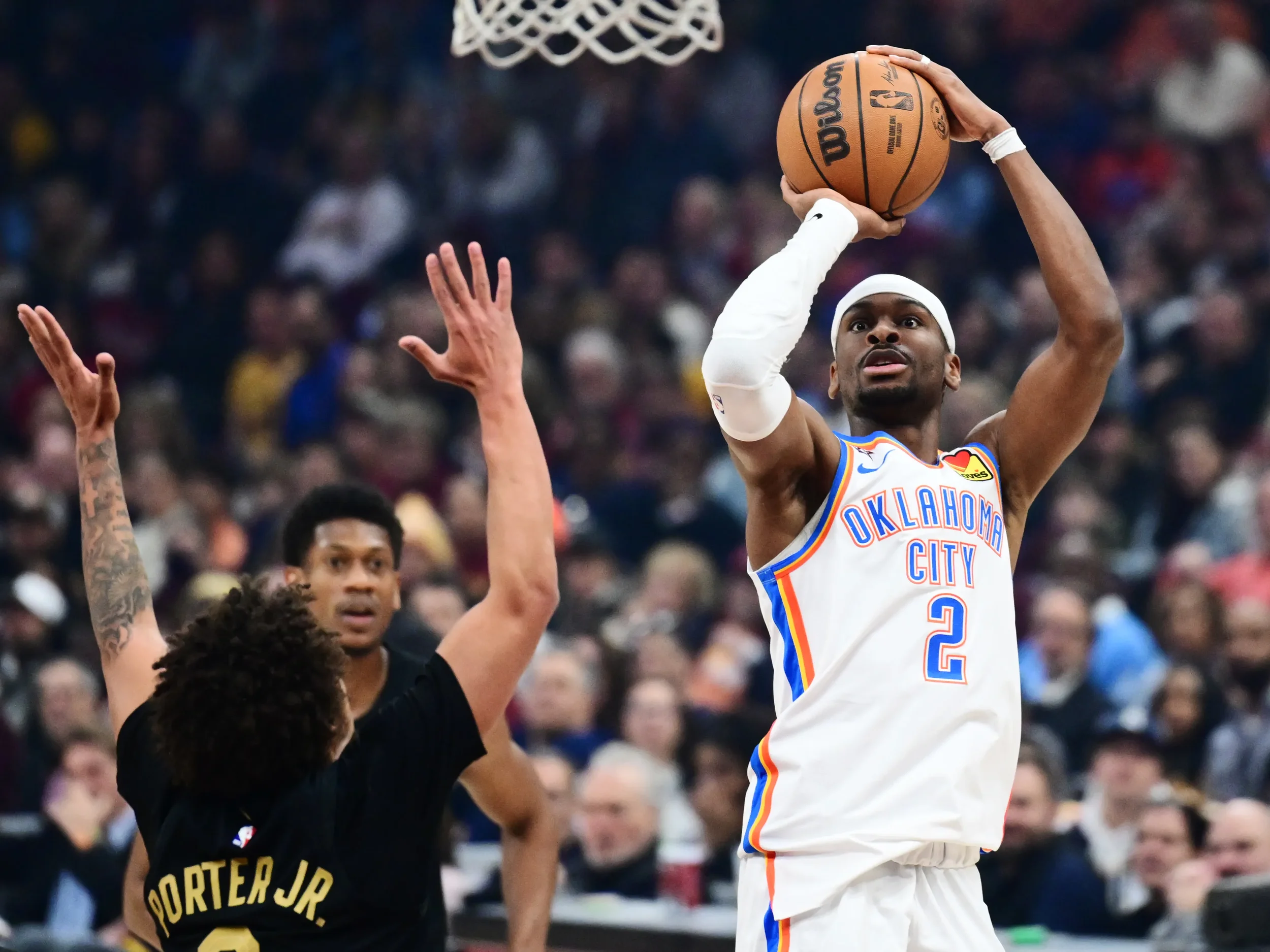
CLEVELAND, Ohio — The Cleveland Cavaliers appeared to have completed an impressive second-half comeback Monday night against the Oklahoma City Thunder, but their inability to close out the game resulted in a frustrating 117-112 defeat at Rocket Arena.
After trailing by as many as 14 points in the third quarter, Cleveland fought back behind a strong perimeter shooting performance and an 18-9 run to open the fourth. However, the Cavaliers failed to maintain their momentum, allowing Oklahoma City to regain control in the final minute.
Thunder superstar Shai Gilgeous-Alexander delivered the decisive blow, connecting on a go-ahead three-pointer with 32.6 seconds remaining to cap a season-high 43-point performance.
The loss dropped Cleveland to 4-3 and marked its first home defeat of the season. Oklahoma City improved to 5-2, snapping a two-game losing streak despite continuing to deal with significant injuries throughout its roster.
For the Cavaliers, the result was particularly disappointing considering their second-half effort. Cleveland had overcome a double-digit deficit and positioned itself to secure a statement victory against one of the Western Conference’s premier teams, only to watch the opportunity disappear in the closing possessions. (NBA)
Cavaliers Overcome 14-Point Deficit to Take Control
Monday’s matchup featured a competitive opening quarter, with Cleveland establishing an early 30-26 advantage.
However, the Cavaliers struggled to maintain their offensive rhythm during the second quarter.
Oklahoma City took advantage of Cleveland’s scoring difficulties, closing the first half on a 16-6 run to establish a 59-48 halftime lead.
The Thunder continued building momentum early in the third quarter, extending their advantage to 69-55 after a pair of Gilgeous-Alexander free throws with 9:26 remaining.
Facing a 14-point deficit, Cleveland needed a significant offensive response.
The Cavaliers delivered one through their perimeter shooting.
Cleveland connected on nine of its 17 three-point attempts during the third quarter, gradually reducing Oklahoma City’s advantage while generating the offensive momentum that had been missing during the first half.
The Cavaliers outscored the Thunder 36-31 in the period, entering the fourth quarter trailing 90-84.
Cleveland then opened the final period with an 18-9 run, turning what had appeared to be a comfortable Oklahoma City advantage into a closely contested game.
The comeback demonstrated the Cavaliers’ offensive potential, particularly when their perimeter shooting created opportunities to attack the Thunder’s defense.
However, the momentum that carried Cleveland back into contention ultimately proved difficult to sustain. (AP)
Fourth-Quarter Lead Slips Away in Final Minute
The final quarter became a back-and-forth contest, featuring eight ties and eight lead changes as neither team managed to establish a comfortable advantage.
Cleveland’s comeback had given the Cavaliers an opportunity to close out the game in front of their home crowd, but Oklahoma City repeatedly answered their scoring possessions.
Gilgeous-Alexander proved to be the difference.
With the game hanging in the balance, the Thunder guard connected on his fourth three-pointer of the evening with 32.6 seconds remaining, putting Oklahoma City ahead.
Cleveland had an opportunity to respond, but Sam Merrill missed a three-point attempt from the corner.
The missed shot proved costly.
Oklahoma City’s Ajay Mitchell subsequently converted two free throws with 15.4 seconds remaining, extending the Thunder’s advantage to two possessions and leaving Cleveland with little time to recover.
The Cavaliers were unable to complete another comeback, falling 117-112.
Although Cleveland outscored Oklahoma City 28-27 in the fourth quarter, its inability to execute in the closing moments ultimately determined the outcome.
The loss highlighted an issue that can separate talented regular-season teams from legitimate championship contenders: the ability to finish close games against elite opponents.
Cleveland demonstrated that it could recover from a substantial deficit, but the Cavaliers could not produce the necessary defensive stops and offensive execution when the game was on the line. (CBS Sports)
Gilgeous-Alexander Delivers 43-Point Performance
While Cleveland’s inability to finish the game will receive considerable attention, Oklahoma City’s victory was largely the result of another exceptional performance from Gilgeous-Alexander.
The Thunder superstar scored a season-high 43 points, adding eight assists while shooting 14-of-35 from the field and 11-of-12 from the free-throw line.
His 35 field-goal attempts represented the highest single-game total by any NBA player through the first two weeks of the season.
Despite facing consistent defensive attention, Gilgeous-Alexander continued attacking Cleveland’s defense and creating scoring opportunities.
His ability to draw fouls and generate points at the free-throw line helped Oklahoma City maintain offensive production even when its perimeter shooting became inconsistent.
Most importantly, he delivered when the Thunder needed him most.
His go-ahead three-pointer in the final minute was the defining moment of the game, allowing Oklahoma City to escape with a victory after surrendering its earlier double-digit advantage.
The performance also matched his highest scoring total in 17 career games against Cleveland.
For a Thunder team dealing with several significant injuries, Gilgeous-Alexander’s ability to carry the offense remains essential to maintaining its position among the Western Conference’s top teams.
Oklahoma City also received 20 points from Ajay Mitchell, while Isaiah Hartenstein contributed 14 rebounds.
Those performances provided important support for Gilgeous-Alexander, particularly during the game’s final possessions. (AP)
Donovan Mitchell and Cavaliers Struggle to Find Consistent Offense
For Cleveland, Donovan Mitchell finished with 17 points, 11 assists and five rebounds, contributing as both a scorer and facilitator.
However, the Cavaliers lacked a dominant individual scoring performance capable of matching Gilgeous-Alexander’s production.
Rookie Meleek Thomas, making his first NBA start, tied Mitchell for the team lead with 17 points.
Evan Mobley added 16 points, but Cleveland struggled to consistently generate efficient offense throughout the contest.
The Cavaliers finished shooting 44.4% from the field, compared with Oklahoma City’s 42.9%.
Cleveland also made 18 three-pointers compared with the Thunder’s 12, providing a significant advantage from beyond the arc.
However, those advantages were offset by difficulties at the free-throw line and on the glass.
The Cavaliers converted just 14 of their 24 free-throw attempts, shooting 58.3%.
Oklahoma City, meanwhile, made 21 of its 23 attempts, an impressive 91.3%.
That difference proved particularly significant in a game decided by five points.
Cleveland also lost the rebounding battle 63-55, allowing the Thunder to generate additional possessions despite shooting a lower percentage from the field.
The Cavaliers finished with 31 assists and only seven turnovers, demonstrating effective ball movement and relatively disciplined offensive execution.
However, their inability to capitalize on free throws and secure critical rebounds ultimately undermined those positive contributions.
Against a team with Oklahoma City’s talent, small mistakes can become the difference between winning and losing. (CBS Sports)
Thunder Overcome Injuries to Snap Losing Streak
Oklahoma City entered Monday’s matchup facing considerable adversity.
The Thunder had lost two consecutive road games by more than 20 points and were attempting to regain momentum while dealing with injuries to three starters.
Those absences placed additional pressure on Gilgeous-Alexander and the team’s remaining healthy contributors.
However, Oklahoma City demonstrated the resilience that has helped establish the franchise as one of the NBA’s strongest organizations.
Despite surrendering a 14-point lead and allowing Cleveland to gain control during the fourth quarter, the Thunder remained composed in the closing minutes.
Gilgeous-Alexander provided the decisive offensive production, while the team’s supporting cast contributed enough to secure the victory.
The result improved Oklahoma City to 5-2 and provided an important response following its recent struggles.
For Cleveland, the loss was especially frustrating because the Cavaliers had an opportunity to defeat a talented but injury-depleted opponent on their home floor.
Instead, Oklahoma City’s ability to execute in critical situations proved to be the difference. (NBC Sports)
Cleveland’s Late-Game Execution Raises Questions
Although the Cavaliers are only seven games into the regular season, Monday’s defeat exposed several areas that require improvement.
Cleveland demonstrated the offensive firepower necessary to overcome a substantial deficit against a quality opponent.
However, the Cavaliers struggled to maintain that production consistently.
Their second-quarter offensive difficulties allowed Oklahoma City to establish an 11-point halftime advantage, forcing Cleveland to expend significant energy recovering during the second half.
The Cavaliers then failed to capitalize on their fourth-quarter comeback, allowing Gilgeous-Alexander to deliver the decisive basket.
Perhaps the most concerning aspect of the loss was Cleveland’s free-throw shooting.
Missing 10 free throws in a five-point defeat represents a substantial missed opportunity.
The Cavaliers also allowed Oklahoma City to control the rebounding battle, an issue that can become particularly damaging against teams with strong interior players.
Cleveland’s defensive performance against Gilgeous-Alexander also raises questions about how the team plans to contain elite perimeter scorers.
While completely shutting down a player of his caliber is unrealistic, allowing 43 points places tremendous pressure on the Cavaliers’ offense to match that production.
If Cleveland hopes to establish itself among the Eastern Conference’s strongest teams, improving its late-game execution and consistency will be essential.
The Cavaliers have demonstrated that they possess the talent to compete with elite opponents. Monday’s result showed that competing and closing out victories remain two different challenges.
Cavaliers Get Immediate Opportunity for Revenge
Cleveland will not have to wait long for another opportunity against Oklahoma City.
The teams are scheduled to meet again Wednesday night, this time at Paycom Center in Oklahoma City, completing an unusual two-game regular-season series.
The rematch provides the Cavaliers with an immediate opportunity to respond to Monday’s disappointing finish.
Cleveland will need to improve its free-throw shooting, limit second-chance opportunities and establish more consistent offensive production throughout all four quarters.
Containing Gilgeous-Alexander will also remain a priority after his 43-point performance.
For Oklahoma City, the objective will be maintaining its momentum and securing a second consecutive victory over an Eastern Conference opponent.
The Thunder have demonstrated their ability to win close games despite injuries, while Cleveland will be looking to prove that Monday’s collapse was an isolated setback rather than an indication of larger concerns.
A Missed Opportunity for Cleveland
Monday night’s defeat will be remembered as a game the Cavaliers had an opportunity to win but could not finish.
Cleveland overcame a 14-point deficit, found its offensive rhythm during the second half and entered the closing minutes with a legitimate chance to secure an important home victory.
However, missed free throws, rebounding difficulties and an inability to contain Gilgeous-Alexander in the final moments ultimately proved too costly.
The Cavaliers finished with more three-pointers, a higher field-goal percentage and significantly more assists than Oklahoma City, yet still walked away with a loss.
Those numbers illustrate how narrow the margin for error can be against championship-caliber competition.
For a Cleveland team hoping to make a deep postseason run, the defeat provides an early reminder that talent alone is not enough.
Executing in the final minutes, securing defensive rebounds and capitalizing on opportunities at the free-throw line are essential components of winning close games.
The Cavaliers have shown they can compete with some of the NBA’s best teams. Their next challenge is demonstrating that they can consistently finish those games.
Cleveland fought its way back from a 14-point deficit and put itself in position to win, but when the game reached its most important moments, Oklahoma City had the answers. The Cavaliers did not.