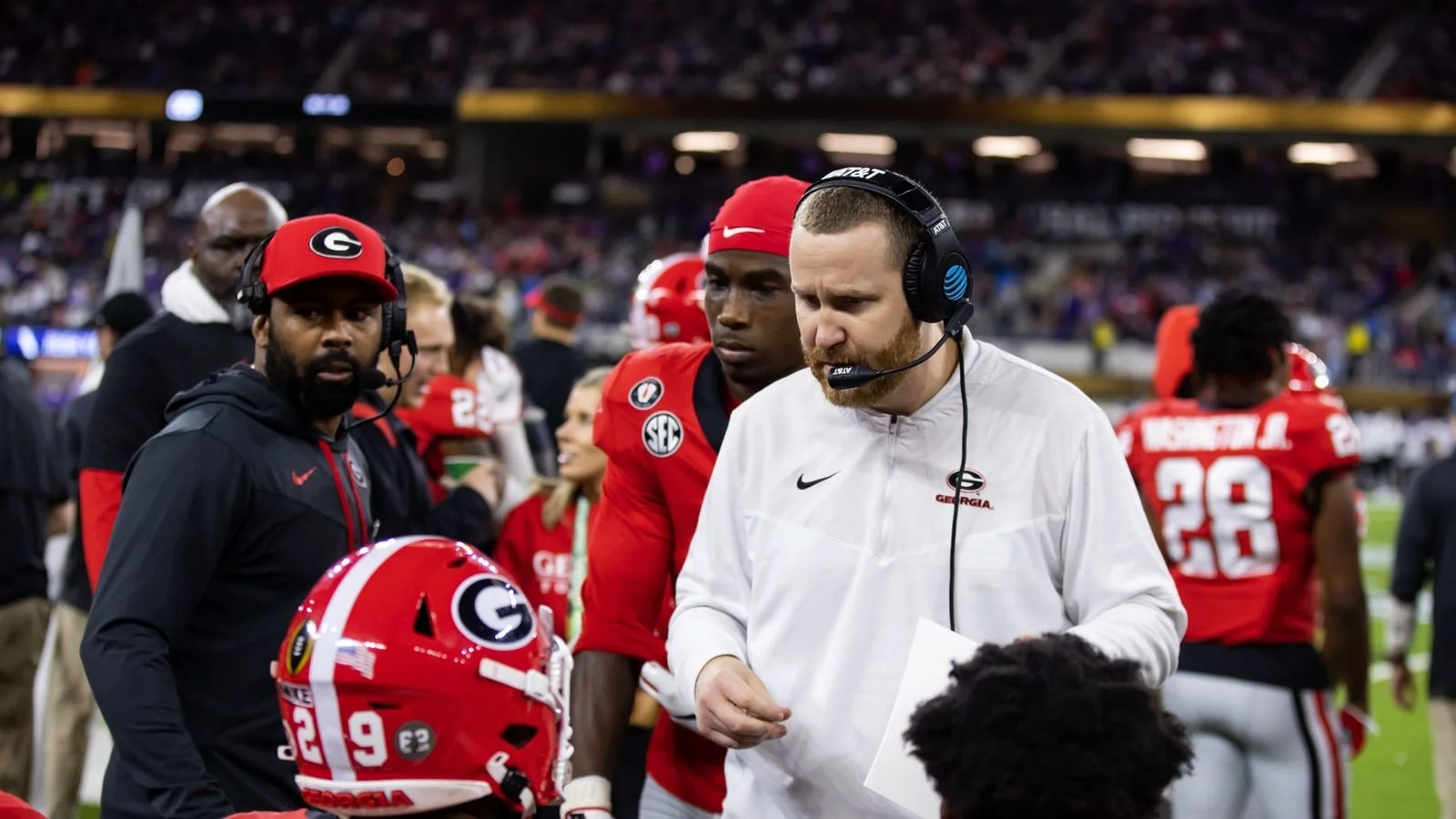
TALLAHASSEE, Fla. — Florida State is turning to one of college football’s most accomplished defensive minds to lead its football program, officially naming Georgia defensive coordinator Glenn Schumann as the Seminoles’ next head coach Monday evening.
Schumann, 36, has agreed to a five-year contract and is expected to remain with Georgia throughout its postseason campaign before fully transitioning into his new role. He replaces Mike Norvell, marking the beginning of a new era in Tallahassee. (Florida State Athletics)
The hiring comes as Florida State looks to reestablish itself as a consistent national championship contender in an increasingly competitive college football landscape.
For Schumann, the opportunity represents the culmination of nearly two decades spent learning under two of the most successful head coaches in modern college football history, Nick Saban and Kirby Smart.
However, perhaps the most interesting development surrounding the hiring came nearly 48 hours before Monday’s announcement, courtesy of South Carolina head coach Shane Beamer and a particularly revealing postgame handshake.
Shane Beamer Foreshadows the Announcement
Following Saturday’s matchup between Georgia and South Carolina, Beamer approached Schumann during the customary postgame handshakes.
What would ordinarily have been a brief exchange between opposing coaches quickly became one of the more intriguing moments of the college football weekend.
“I hope the FSU thing works out if that’s what you want,” Beamer told Schumann.
The interaction quickly circulated across social media, with Florida State fans interpreting Beamer’s comments as an indication that Schumann had emerged as the leading candidate for the position.
Beamer and Schumann previously worked together on Georgia’s coaching staff during the 2016 and 2017 seasons, making the exchange considerably more personal than a traditional postgame handshake between opposing coaches.
Although Beamer stopped short of publicly confirming that an agreement had been reached, the conversation offered an unusually candid glimpse into the coaching carousel and how much information can circulate privately among coaches before becoming public knowledge.
What initially appeared to be a friendly conversation between former colleagues ultimately served as an unofficial preview of Florida State’s next coaching chapter.
A Coaching Résumé Built on Championships
Few first-time head coaches enter their new positions with the championship pedigree that Schumann brings to Florida State.
Schumann began his coaching career at Alabama in 2008, working within Nick Saban’s program while completing his undergraduate degree. He gradually earned greater responsibilities within the organization, spending eight seasons in Tuscaloosa and contributing to four national championship teams.
When Kirby Smart accepted the Georgia head coaching position ahead of the 2016 season, Schumann followed him to Athens, becoming a member of Smart’s inaugural coaching staff.
Initially responsible for coaching Georgia’s inside linebackers, Schumann became co-defensive coordinator in 2019 before eventually assuming sole defensive coordinator responsibilities in 2024. (Georgia Athletics)
During his tenure in Athens, Schumann helped construct some of the most dominant defenses in recent college football history, including the units that propelled Georgia to consecutive national championships following the 2021 and 2022 seasons.
Georgia’s historic 2021 defense surrendered just 10.2 points per game and produced five first-round selections in the 2022 NFL Draft, establishing a record for defensive players selected from one school in the opening round.
Throughout his time at Alabama and Georgia, Schumann has been part of six national championships. His coaching career has also included the development of numerous NFL Draft selections and All-American defensive players.
His experience extends beyond defensive play-calling. Schumann has established himself as an accomplished recruiter, talent evaluator and position coach, three qualities that have become increasingly important in the modern college football landscape.
That ability to develop talent rather than simply recruit it could become one of Schumann’s most valuable attributes as he attempts to rebuild Florida State.
Florida State Looks to Reestablish Its National Identity
Florida State’s decision to pursue Schumann represents a significant philosophical shift for a program that has spent much of its recent history under offensive-minded head coaches.
The Seminoles are not simply looking for someone capable of improving their defensive performance. They are searching for a head coach capable of establishing a sustainable foundation for a program with national championship expectations.
Florida State’s undefeated 2023 regular season demonstrated that the program remained capable of competing at the highest level. However, its controversial exclusion from the College Football Playoff, followed by a disastrous 2-10 campaign in 2024, exposed how quickly momentum can disappear in modern college football. (ESPN)
The challenge facing Schumann will be establishing consistency rather than simply producing an occasional championship-caliber season.
Georgia’s success under Smart has largely been built through dominant recruiting classes, physicality along the line of scrimmage, defensive discipline and the development of NFL-level talent.
Those are characteristics Florida State will undoubtedly hope Schumann can replicate in Tallahassee.
The Seminoles possess several advantages, including a nationally recognizable brand, a rich championship history and access to one of the most talent-rich recruiting territories in the country.
However, Florida State must compete with Miami, Florida and numerous SEC programs for the state’s premier high school prospects. Schumann’s established recruiting relationships throughout the Southeast could prove particularly valuable in rebuilding Florida State’s roster.
The Challenges of Becoming a First-Time Head Coach
Despite his impressive résumé, Schumann enters Tallahassee facing a challenge he has never previously encountered: overseeing an entire college football program.
The transition from defensive coordinator to head coach requires considerably more than schematic expertise. Schumann will now be responsible for constructing an entire coaching staff, managing roster retention, navigating the transfer portal, overseeing recruiting operations and establishing an offensive identity.
His offensive coordinator hire could ultimately become one of the most consequential decisions of his early tenure.
While Georgia has built much of its reputation around defensive dominance, the Bulldogs have also benefited from efficient offenses, strong quarterback play and considerable investment along the offensive line.
Schumann will need to establish a similar balance at Florida State rather than relying exclusively on the defensive principles that defined his rise through the coaching ranks.
There is, however, a successful precedent for hiring a highly regarded defensive coordinator without previous head coaching experience.
Kirby Smart arrived at Georgia in 2016 after serving as Alabama’s defensive coordinator under Saban. Dan Lanning followed a similar path when he departed Georgia for Oregon following the 2021 season. (Oregon Athletics)
Both demonstrated that experience within a championship-caliber organization can provide a strong foundation for becoming a successful head coach.
Florida State is betting that Schumann can follow a similar trajectory.
A Personal Connection to Tallahassee
Beyond his professional qualifications, Schumann also possesses a unique family connection to Florida State.
His grandfather, Jack Haskin, served as an assistant coach during Florida State’s inaugural football season in 1947, providing a historical connection between Schumann and the program that dates back nearly eight decades.
Schumann himself was born in Valdosta, Georgia, less than 100 miles from Tallahassee, providing another regional connection to the program he will now oversee.
For a coach who has spent his professional career within the SEC, the opportunity to lead Florida State carries significance beyond simply accepting his first head coaching position.
It also represents an opportunity to contribute to a program in which his family played a role during its earliest years.
Nearly eight decades after his grandfather helped establish Florida State football, Schumann will now be responsible for guiding the program into its next chapter.
Georgia Faces Another Significant Coaching Departure
For Kirby Smart, Schumann’s departure represents another substantial loss from a coaching staff that has consistently produced head coaching candidates across college football.
Schumann has been with Smart since the beginning of his tenure in Athens, helping transform Georgia from a perennial SEC contender into one of the defining programs of the modern college football era.
His departure will leave a considerable void, particularly in defensive preparation, recruiting and linebacker development.
Schumann is expected to remain with Georgia throughout its postseason run, a situation similar to Lanning’s departure for Oregon following the 2021 season.
Lanning continued his defensive responsibilities at Georgia throughout the College Football Playoff despite having already accepted Oregon’s head coaching position, ultimately helping the Bulldogs capture their first national championship in more than four decades.
Georgia has successfully navigated similar coaching transitions in recent years, but Schumann’s longevity within the organization makes this departure particularly significant.
He has been present throughout Georgia’s transformation, helping establish the defensive standards and organizational culture that have become synonymous with Smart’s program.
Replacing that institutional knowledge will be just as important as replacing his defensive play-calling responsibilities.
A New Era Begins in Tallahassee
Florida State’s hiring of Schumann is an investment in long-term program development rather than an established head coaching résumé.
The Seminoles are placing their confidence in a coach who has spent nearly two decades observing how championship programs recruit, develop talent, establish accountability and sustain success.
There will undoubtedly be growing pains associated with his transition into a head coaching position, particularly given the immediate expectations surrounding a program of Florida State’s stature.
Nevertheless, Schumann represents one of the more intriguing coaching hires in college football. His age, championship experience, recruiting background and defensive expertise provide Florida State with an opportunity to establish a foundation capable of producing sustained success.
The immediate priorities will be assembling a competitive coaching staff, retaining key contributors and capitalizing on the upcoming recruiting and transfer portal windows. His ability to successfully navigate those responsibilities while fulfilling his postseason commitment to Georgia will provide an early indication of how prepared he is for the demands of his new position.
For nearly two decades, Schumann has helped build championship programs under the direction of others. Now, he will have the opportunity to build one of his own.
And fittingly enough, the first public indication of his next chapter came not from a university announcement or a national college football insider, but from an opposing head coach during a Saturday postgame handshake.