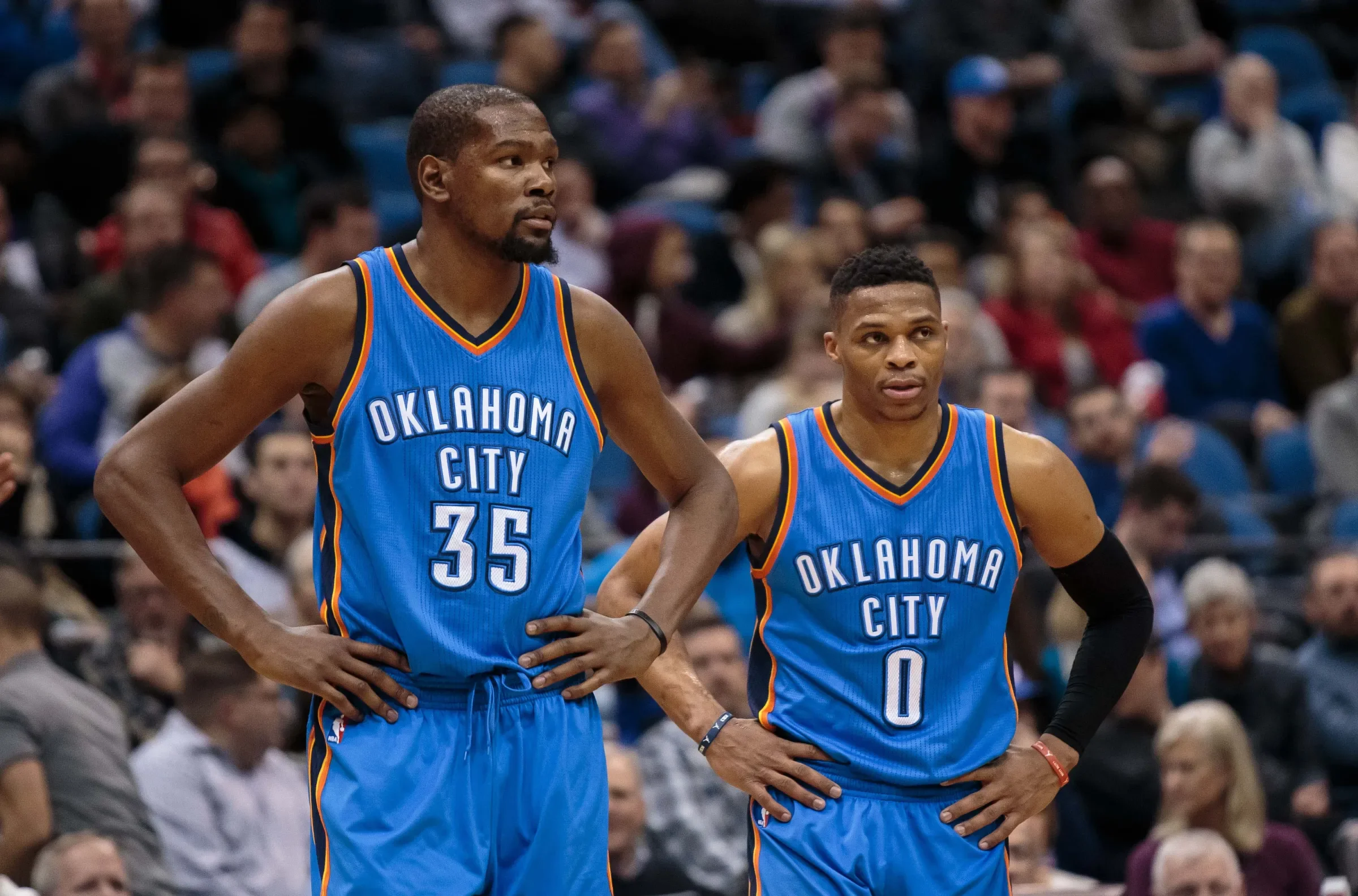
OKLAHOMA CITY, Okla. — One of the most electrifying players in NBA history is receiving the ultimate recognition from the franchise he helped build into a perennial championship contender.
The Oklahoma City Thunder announced Monday that they will officially retire Russell Westbrook’s iconic No. 0 jersey on February 7, 2027, during a home game against the New York Knicks at Paycom Center. The ceremony will celebrate a player whose remarkable 18-year NBA career included a Most Valuable Player award, nine All-Star selections, four seasons averaging a triple-double and an NBA record 209 career triple-doubles. (theScore)
For Westbrook, who announced his retirement in August at age 37, the honor represents much more than a recognition of his statistical accomplishments. It marks the permanent celebration of a player who became the face of Oklahoma City basketball during the franchise’s formative years and remained loyal to the organization during one of its most uncertain periods.
Across 11 seasons with the Thunder, Westbrook developed from an explosive young point guard into one of the most dominant and recognizable players of his generation. His relentless approach, extraordinary athleticism and historic production transformed him into a franchise icon whose influence extended far beyond the basketball court.
Now, the number that accompanied so many of those memorable moments will hang permanently above the floor where much of his legacy was established.
From Fourth Overall Pick to the Face of a Franchise
Westbrook’s journey to NBA superstardom began in 2008, when the Seattle SuperSonics selected the UCLA guard with the fourth overall pick in the NBA Draft, shortly before the franchise relocated to Oklahoma City.
At the time, Westbrook was considered an exceptional athlete with considerable upside, although questions remained about his development as a traditional point guard. Those concerns quickly disappeared as his explosiveness, competitive mentality and ability to impact nearly every aspect of the game became apparent.
During his rookie season in 2008-09, Westbrook averaged 15.3 points, 5.3 assists and 4.9 rebounds, earning NBA All-Rookie First Team honors and establishing himself as a foundational piece of the Thunder’s future.
Alongside Kevin Durant, who had been drafted the previous year, and James Harden, who arrived in 2009, Westbrook helped form one of the most promising young cores in NBA history.
The Thunder reached the playoffs in 2010, advanced to the Western Conference Finals in 2011 and made their first NBA Finals appearance in 2012.
Although Oklahoma City ultimately lost the 2012 championship series to LeBron James, Dwyane Wade and the Miami Heat, the appearance demonstrated how quickly the franchise had developed into a legitimate contender.
Westbrook’s combination of explosive drives, aggressive defense, transition scoring and relentless energy made him an essential component of that success. He was no longer simply an athletic young guard with potential. He had become one of the league’s premier players. (NBA)
The Departure of Kevin Durant and Westbrook’s Defining Moment
Perhaps no period better defined Westbrook’s relationship with Oklahoma City than the summer of 2016.
After years of competing alongside Durant, Westbrook watched his longtime teammate leave the Thunder to join the Golden State Warriors, a team that had just eliminated Oklahoma City in the Western Conference Finals.
Durant’s departure fundamentally altered the franchise’s championship aspirations and raised immediate questions about its future.
Westbrook, however, chose a different path.
Rather than pursuing an opportunity elsewhere, he committed himself to Oklahoma City and embraced the responsibility of becoming the unquestioned leader of the organization.
What followed was one of the most remarkable individual seasons in NBA history.
During the 2016-17 campaign, Westbrook averaged 31.6 points, 10.7 rebounds and 10.4 assists per game, becoming the first player since Oscar Robertson in 1961-62 to average a triple-double across an entire season.
Westbrook also recorded 42 triple-doubles, breaking Robertson’s single-season record of 41, which had stood for more than five decades.
His performances were frequently extraordinary, highlighted by dramatic fourth-quarter comebacks, game-winning shots and scoring outbursts that demonstrated his ability to carry an offense almost single-handedly.
One of the defining moments came on April 9, 2017, against the Denver Nuggets.
Westbrook delivered 50 points, 16 rebounds and 10 assists, securing his record-breaking 42nd triple-double of the season while hitting a dramatic game-winning three-pointer at the buzzer.
It was a performance that captured everything that made Westbrook such a remarkable player: the ability to dominate statistically while delivering in the most important moments.
He finished the season by winning the 2016-17 NBA Most Valuable Player award, becoming the first player to capture the honor while averaging a triple-double since Robertson.
Although Oklahoma City was eliminated in the first round of the playoffs, Westbrook’s individual season remains one of the most statistically impressive campaigns the league has ever witnessed. (NBA)
Redefining the Triple-Double and Making NBA History
Before Westbrook entered his prime, averaging a triple-double across an entire NBA season was widely regarded as one of basketball’s most difficult accomplishments.
Robertson had achieved the feat in 1961-62, but more than half a century passed without another player matching it.
Westbrook did not simply repeat the accomplishment. He made it a regular occurrence.
Following his historic MVP campaign, Westbrook averaged a triple-double in each of the next two seasons with Oklahoma City, becoming the first player in league history to accomplish the feat in three consecutive years.
He would eventually achieve the milestone for a fourth time during the 2020-21 season with the Washington Wizards.
His ability to combine elite scoring, rebounding and playmaking fundamentally challenged traditional expectations for point guards.
Westbrook routinely collected rebounds against much taller opponents, initiated fast breaks immediately after securing possession and created scoring opportunities through his ability to attack the basket.
On May 10, 2021, while playing for Washington, Westbrook recorded his 182nd career triple-double, surpassing Robertson’s longstanding NBA record.
By the time he retired in August 2026, Westbrook had accumulated 209 regular-season triple-doubles, the most in NBA history.
He also finished with 221 combined regular-season and postseason triple-doubles, tying Nikola Jokić for the most in league history at the time of his retirement.
Perhaps most impressively, Westbrook’s teams won 153 of the 209 regular-season games in which he recorded a triple-double, a winning percentage of approximately 73.2%.
The numbers illustrate that his historic production was frequently accompanied by team success, despite years of criticism concerning his statistical approach and decision-making. (NBA)
A Career Filled With Historic Accomplishments and Accolades
Westbrook’s legacy extends well beyond his triple-double records.
Throughout his 18 NBA seasons, he accumulated an extraordinary collection of individual honors and established himself among the most productive guards in league history.
His career accomplishments include:
2016-17 NBA Most Valuable Player
Nine-time NBA All-Star
Nine-time All-NBA selection
Two-time NBA scoring champion
Three-time NBA assists leader
Two-time NBA All-Star Game MVP
Four seasons averaging a triple-double
NBA record 209 career regular-season triple-doubles
NBA record 42 triple-doubles in a single season
2012 Olympic gold medalist with Team USA
Member of the NBA’s 75th Anniversary Team
2012 NBA Finals appearance with Oklahoma City
Westbrook finished his career averaging 20.9 points, 8.0 assists, 6.9 rebounds and 1.6 steals across 1,301 regular-season games.
He also retired as one of only two players, alongside LeBron James, to rank among the NBA’s top 15 all-time leaders in points, assists and steals.
His 9,025 career rebounds represented the most ever recorded by a guard, another indication of how dramatically he expanded the responsibilities traditionally associated with his position.
Westbrook also accumulated 12,094 points in the paint, the most by a guard during the 30-year period for which the NBA has maintained detailed shot-location data.
His production was particularly remarkable because of the physical demands of his playing style. Few guards in league history attacked the basket with his combination of speed, power and determination.
While Westbrook never won an NBA championship, his collection of individual accomplishments places him among the most decorated point guards of his generation and establishes an overwhelming case for eventual induction into the Naismith Memorial Basketball Hall of Fame. (NBA)
Eleven Seasons That Defined Oklahoma City Basketball
Although Westbrook played for several organizations during the later stages of his career, his years in Oklahoma City remain the defining chapter of his basketball journey.
From 2008 through 2019, Westbrook appeared in 821 regular-season games for the Thunder, accumulating 18,859 points, 6,897 assists, 5,760 rebounds and 1,442 steals.
He helped establish Oklahoma City as one of the Western Conference’s most competitive franchises and played a significant role in transforming a newly relocated organization into one with a passionate national following.
The Thunder reached four Western Conference Finals during Westbrook’s tenure, including their NBA Finals appearance in 2012.
Following Durant’s departure, Westbrook became the organization’s centerpiece and helped maintain Oklahoma City’s playoff competitiveness.
His relationship with the city also became increasingly significant.
Unlike many professional athletes whose connection to a franchise is defined primarily by championships or individual awards, Westbrook developed a personal bond with Oklahoma City through his loyalty, community involvement and willingness to remain with the organization when its future appeared uncertain.
That connection was reflected in the Thunder’s announcement.
Thunder Chairman Clayton I. Bennett praised Westbrook’s enduring relationship with the organization and the Oklahoma community, emphasizing that his impact continued long after his departure.
General manager Sam Presti similarly recognized Westbrook’s mentality, dedication and contributions both on and off the court.
For Oklahoma City, retiring No. 0 represents an acknowledgment of a player who helped establish the franchise’s identity during its earliest and most important years. (KTUL)
Life After Oklahoma City and the Final Chapters of His Career
Westbrook’s departure from Oklahoma City came in July 2019, when the Thunder traded him to the Houston Rockets in a deal involving Chris Paul and draft compensation.
The move reunited Westbrook with former Thunder teammate James Harden and marked the beginning of a period in which he would play for several different organizations.
After one season in Houston, Westbrook was traded to the Washington Wizards, where he produced another historic campaign during the 2020-21 season.
He averaged 22.2 points, 11.5 rebounds and 11.7 assists, leading the league in assists while recording his fourth career season averaging a triple-double.
Westbrook subsequently joined the Los Angeles Lakers in 2021, although his time alongside LeBron James and Anthony Davis was marked by inconsistent team results and persistent questions about his offensive fit.
He later played for the Los Angeles Clippers, Denver Nuggets and Sacramento Kings, adapting to different roles as his career progressed.
His later seasons were not without difficulties.
Westbrook’s declining shooting efficiency, reduced explosiveness and struggles in certain offensive systems led to criticism, particularly during his tenure with the Lakers.
His aggressive style sometimes resulted in turnovers and questionable shot selection, while his inability to consistently threaten defenses from three-point range became an increasingly significant limitation.
Nevertheless, Westbrook continued to demonstrate the competitive mentality that had defined his career.
He accepted reserve responsibilities at different stages, contributed as a secondary playmaker and remained capable of influencing games through his rebounding, energy and transition offense.
In August 2026, Westbrook officially announced his retirement, concluding an 18-season career that stretched across multiple eras of NBA basketball.
While his pursuit of an NBA championship ultimately went unfulfilled, his individual accomplishments and influence on the evolution of the point guard position remained undeniable. (NBA)
A Legacy Beyond Basketball
Westbrook’s influence has never been confined exclusively to the basketball court.
Throughout his career, he developed a reputation for supporting underserved communities, particularly through the Russell Westbrook Why Not? Foundation.
The organization has focused on educational opportunities, workforce development and mental health resources, with the broader objective of creating opportunities for young people and families facing economic and social challenges.
Westbrook also became a prominent figure in fashion and popular culture, developing a distinctive personal style that helped establish his identity beyond professional basketball.
His personality, confidence and willingness to express himself made him one of the NBA’s most recognizable athletes.
In Oklahoma City, however, his connection with the community carried particular significance.
Westbrook’s decision to remain with the Thunder after Durant’s departure became a defining moment for a fan base that had experienced the disappointment of losing one of the greatest players in franchise history.
For many supporters, Westbrook represented loyalty during a period when the organization’s long-term direction was uncertain.
That relationship endured even after his departure in 2019, making his upcoming jersey retirement a celebration of both his basketball achievements and his personal connection to the city. (NBA)
Where Westbrook Ranks Among the Greatest Point Guards in NBA History
Evaluating Westbrook’s place among the greatest point guards in basketball history requires considering both his extraordinary statistical production and the limitations that accompanied his playing style.
His résumé compares favorably with many of the position’s most accomplished players.
Magic Johnson, Stephen Curry, Oscar Robertson, Isiah Thomas and other legendary guards built their reputations through combinations of individual excellence, championship success and influence on the game.
Westbrook’s career followed a different trajectory.
He never captured an NBA championship and frequently faced criticism for his shooting efficiency and decision-making in high-pressure situations.
His career three-point percentage of 30.8% also highlights one of the most significant weaknesses in his offensive game, particularly as the NBA increasingly emphasized perimeter shooting and spacing.
Yet Westbrook’s statistical achievements remain almost impossible to overlook.
No player in NBA history has recorded more regular-season triple-doubles, and no other player had averaged a triple-double in four different seasons when Westbrook retired.
His ability to generate offense, rebound against larger opponents and control the pace of games made him one of the most unique players the league has ever seen.
Westbrook may not have possessed the championship résumé of Johnson or Curry, but his peak production, longevity and influence on the modern point guard position ensure that he belongs in discussions about the greatest players at his position.
His career also raises an interesting question about how basketball greatness should be measured.
Championships remain an important part of a player’s legacy, but individual brilliance, consistency, longevity and historical significance also deserve considerable weight.
Westbrook’s accomplishments demonstrate that a player can fundamentally change expectations for a position without necessarily achieving the ultimate team prize.
No. 0 Will Forever Represent an Era of Thunder Basketball
When Oklahoma City raises Westbrook’s jersey into the rafters on February 7, 2027, the ceremony will recognize much more than the franchise’s former point guard.
It will commemorate the player who helped introduce the Thunder to the national basketball landscape, carried the organization through the departure of another superstar and delivered one of the most remarkable individual seasons in NBA history.
Westbrook will join Nick Collison among the players whose numbers have been retired specifically for their contributions to the Oklahoma City era of the franchise.
The significance of that recognition extends beyond the franchise’s record books.
Westbrook was part of the Thunder’s first generation of stars, helping create the competitive foundation and basketball culture that subsequent teams would inherit.
His explosive playing style, emotional intensity and relentless competitiveness became synonymous with Oklahoma City basketball.
For 11 seasons, he gave the organization a recognizable identity, providing unforgettable moments for a fan base that embraced him as one of its own.
The Thunder’s decision to retire No. 0 ensures that future generations of Oklahoma City players and supporters will recognize his contributions to the franchise’s history.
Russell Westbrook’s career was not perfect. His playing style generated criticism, his pursuit of a championship ended without a title, and his later seasons presented challenges that tested his ability to adapt.
But few players have ever competed with his combination of intensity, athleticism and determination, and even fewer have produced the historical numbers that defined his prime.
An MVP award, nine All-Star selections, 209 triple-doubles and four seasons averaging a triple-double represent a career that will be remembered for generations.
For Oklahoma City, however, the legacy is even more personal.
Westbrook was there when the Thunder were establishing themselves. He helped make the franchise relevant, stayed when its future was uncertain and became one of the most beloved figures in the city’s professional sports history.
On February 7, his No. 0 will rise into the rafters, permanently honoring a player who gave Oklahoma City some of the most memorable moments in its basketball history.
The number will never be worn by another Thunder player. The legacy behind it will remain forever.