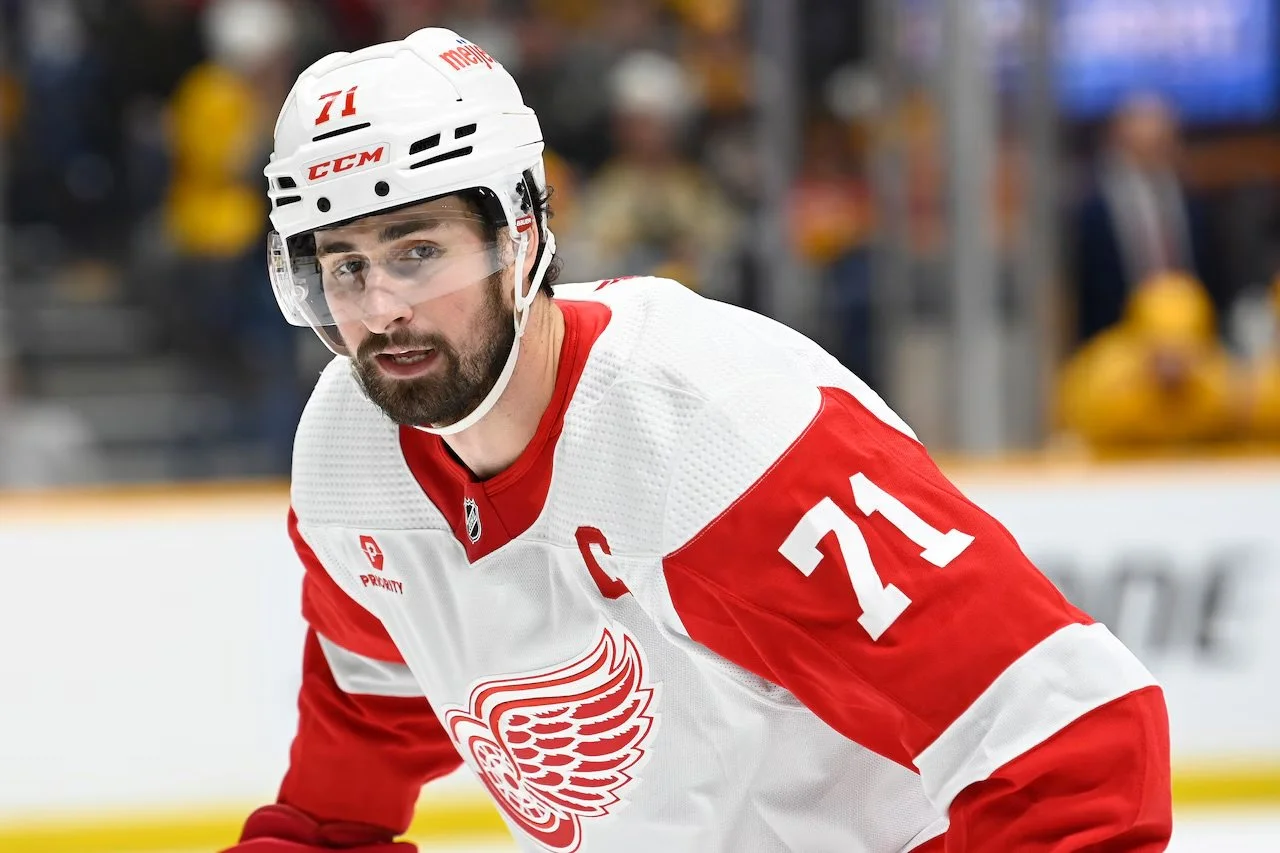
DETROIT, MI — What was once an unusual occurrence in the National Hockey League is quickly becoming one of the league’s most controversial developing trends.
The Detroit Red Wings have suspended former captain Dylan Larkin without pay after the veteran center informed the organization that he would no longer play until his trade request was fulfilled. The decision marks a dramatic escalation in an already strained relationship between Larkin and the only NHL franchise he has ever represented.
The situation comes on the heels of a similar dispute involving star goaltender Connor Hellebuyck and the Winnipeg Jets, raising questions about whether the NHL is entering a new era of player empowerment, one that has become increasingly familiar in the NFL and NBA but remains relatively uncommon in professional hockey. (NHL)
Larkin’s Relationship With Detroit Reaches a Breaking Point
Larkin’s frustration with the Red Wings has been building for months, dating back to his trade request during the offseason following Detroit’s 10th consecutive season without a playoff appearance.
The 30-year-old center, who had served as Detroit’s captain since January 2021, was removed from that role in September as the organization prepared for the 2026-27 season. Despite the growing uncertainty surrounding his future, Larkin initially reported to the team and continued playing while management explored potential trades.
Through his first 10 appearances this season, Larkin recorded two goals and four assists while remaining one of Detroit’s most heavily utilized forwards.
However, with October nearing its conclusion and no trade completed, Larkin apparently reached his limit.
On Thursday, interim general manager Shawn Horcoff confirmed that Larkin had informed the organization of his decision to stop playing, prompting an immediate suspension without pay.
“Dylan Larkin has informed us that he will no longer play for the Detroit Red Wings,” Horcoff said in a statement.
“We are disappointed by his decision, particularly given his obligations to the organization and his teammates. We have therefore suspended Dylan without pay.”
Horcoff emphasized that Detroit would continue exploring trade possibilities, but made clear that the organization would not sacrifice its long-term interests simply to accommodate Larkin’s demands.
Larkin’s agent, Pat Brisson, offered a different perspective, explaining that his client believed he had already demonstrated considerable patience throughout the process.
“Dylan’s had enough of the situation,” Brisson said. “We believe he’s been very professional and cooperative through this process.”
The suspension represents a significant turning point for a player who has spent his entire NHL career in Detroit and was once viewed as a central figure in the franchise’s rebuilding efforts. (Sportsnet)
The Financial Consequences and Complications of a Trade
Larkin’s decision is not without substantial financial consequences.
The veteran center is currently playing under an eight-year, $69.6 million contract signed in March 2023, carrying an average annual salary-cap hit of $8.7 million.
With Detroit suspending him without pay, Larkin reportedly stands to forfeit approximately $41,000 for every day the suspension remains in effect.
Beyond the financial implications, the structure of his contract has complicated Detroit’s ability to facilitate a trade.
Larkin possesses a full no-movement clause, giving him considerable control over his potential destination. He initially identified only three teams he would consider joining before reportedly expanding that list to 10 organizations.
Those teams include the Minnesota Wild, Florida Panthers, Vegas Golden Knights, Dallas Stars, Washington Capitals, Carolina Hurricanes, Tampa Bay Lightning, Colorado Avalanche, New Jersey Devils and Utah Mammoth.
Although the expanded list provides Detroit with additional options, the Red Wings still face the challenge of finding a team willing to absorb Larkin’s contract while offering an acceptable return.
For Detroit, trading a longtime franchise cornerstone for an inadequate package could create problems extending well beyond the current season.
For Larkin, however, every additional day without a resolution represents another missed opportunity to begin the next chapter of his career. (USA Today)
Connor Hellebuyck’s Holdout Set the Stage for Another NHL Standoff
Larkin’s decision comes shortly after another prominent NHL star took an unusually aggressive approach toward forcing a change of scenery.
Connor Hellebuyck’s relationship with the Winnipeg Jets deteriorated after the decorated goaltender requested a trade during the offseason.
Unlike Larkin, who initially reported and continued playing for Detroit, Hellebuyck declined to report to training camp while awaiting a resolution.
Winnipeg responded by suspending the goaltender, creating a public dispute involving one of the NHL’s most accomplished players at his position.
Hellebuyck’s situation eventually ended with a trade to the New Jersey Devils, demonstrating that a prolonged standoff between a star player and his organization can ultimately result in a departure.
The similarities between the two situations are difficult to ignore.
Both players were established stars with significant contractual commitments. Both sought departures from organizations with which they had become closely associated. And both ultimately used their willingness to withhold their services as leverage in negotiations.
There are also important differences. Hellebuyck chose not to report at the beginning of the season, while Larkin initially attempted to continue playing through the uncertainty before deciding he would no longer participate.
That distinction matters because Larkin’s decision came after he had already spent weeks sharing a locker room with teammates while awaiting a trade.
Although contract disputes and trade requests have existed throughout NHL history, two high-profile veterans engaging in such public standoffs within the same season is an extraordinary development for a league where these tactics have traditionally been less common.
The NHL has seen contentious player departures before, but the timing and similarities of these two cases make them particularly noteworthy. (USA Today)
A Common Strategy in the NFL and NBA, but a Different Reality in Hockey
While the situations involving Larkin and Hellebuyck have attracted considerable attention throughout the hockey world, similar disputes have become familiar storylines in other major North American professional sports.
In the NFL, players have frequently withheld their participation from training camps, practices and other team activities to negotiate new contracts or pressure organizations into facilitating trades.
One notable example came in 2021, when quarterback Deshaun Watson requested a trade from the Houston Texans and did not play during the regular season. His situation involved additional and significant complications, including allegations of sexual misconduct and legal proceedings, making it far more complex than an ordinary contract dispute.
Nevertheless, Watson’s eventual trade to the Cleveland Browns in 2022 demonstrated the enormous influence a franchise quarterback could exert over an organization’s direction.
Another example came in 2018, when running back Le’Veon Bell refused to sign his franchise tender with the Pittsburgh Steelers and ultimately sat out the entire season.
Bell’s dispute was primarily about compensation and long-term security rather than a specific trade destination, but it illustrated a player’s willingness to sacrifice substantial earnings to gain leverage over an organization.
The NBA has experienced even more prominent examples of superstar trade demands.
In 2023, James Harden publicly requested a trade from the Philadelphia 76ers and became involved in an increasingly contentious dispute with team president Daryl Morey. Harden eventually joined the Los Angeles Clippers after months of uncertainty.
Similarly, Ben Simmons refused to participate for the 76ers at the beginning of the 2021-22 season, resulting in fines and a prolonged standoff before Philadelphia traded him to the Brooklyn Nets in February 2022.
These situations helped establish a modern reality in professional basketball: a star player’s desire to leave can significantly influence an organization’s decisions, even when that player remains under contract.
The NHL, however, operates under different circumstances.
Hockey rosters contain larger groups of regularly contributing players, superstar contracts generally account for a different share of a team’s salary structure, and the league’s hard salary cap makes complex trades particularly challenging.
Additionally, hockey has historically maintained a strong cultural emphasis on collective responsibility, dressing-room relationships and players fulfilling their contractual obligations.
That does not mean NHL players lack leverage, but it helps explain why the actions of Larkin and Hellebuyck have generated such considerable attention.
The broader question is whether these disputes represent isolated circumstances or the beginning of a more substantial shift in how NHL players approach their careers and contractual commitments.
Why These Situations Are More Complicated Than Simple Trade Demands
It would be easy to characterize Larkin’s refusal to play as another example of a professional athlete attempting to force his way out of an unfavorable situation.
However, the circumstances surrounding Detroit’s former captain are more complicated.
Larkin has spent more than a decade with the Red Wings, remaining with the organization throughout an extended rebuilding process that has yet to produce a return to the Stanley Cup Playoffs.
During that period, he became one of Detroit’s most recognizable players, served as captain and consistently produced offensively despite the team’s struggles.
From his perspective, the desire to compete for a Stanley Cup while still in the prime years of his career is understandable.
Yet Detroit also has legitimate concerns.
The Red Wings are responsible for building a competitive roster, maintaining financial flexibility and protecting the value of their most important assets.
Agreeing to an unfavorable trade simply because a player refuses to participate could establish a precedent that weakens the organization’s negotiating position in future situations.
There is also the question of responsibility to teammates.
When a prominent player decides to stop playing, the consequences extend beyond management. Coaches must adjust their lineups, teammates must assume additional responsibilities, and the organization must address the uncertainty surrounding its locker room.
At the same time, players who possess contractual trade protections have negotiated those rights as part of their agreements.
Larkin’s no-movement clause provides him with legitimate authority over his next destination, even if his refusal to play carries separate disciplinary consequences.
These competing interests make the situation considerably more nuanced than simply determining which side is right or wrong.
Could Player Holdouts Become More Common Across the NHL?
The most significant question emerging from these disputes may have less to do with where Larkin ultimately lands and more to do with what his actions could mean for the NHL moving forward.
For decades, hockey’s trade market has largely operated through private negotiations between general managers, with players occasionally expressing preferences or formally requesting moves.
Public refusals to play have generally remained exceptions rather than established negotiating strategies.
However, the circumstances involving Hellebuyck and Larkin could influence how other high-profile players evaluate their options when relationships with their organizations deteriorate.
If players believe withholding their services can accelerate trade negotiations, more may eventually consider the same approach.
Conversely, the financial penalties, reputational consequences and uncertainty associated with these disputes could discourage others from following that path.
The NHL’s guaranteed contracts and collectively bargained rules also create a different financial environment than the NFL, where many players have historically used holdouts to negotiate greater contractual security.
And unlike the NBA, where individual superstars can dramatically alter a franchise’s championship prospects, hockey’s greater reliance on roster depth can make organizations less willing to accommodate demands at any cost.
There is no guarantee that the league will experience the same level of player-driven movement seen in professional basketball or football.
Still, the emergence of two prominent disputes in such a short period raises an important question about the balance of power between NHL organizations and their most valuable players.
What Comes Next for Detroit and Larkin?
For the Red Wings, the immediate priority is finding a resolution that allows the organization to move forward without compromising its long-term plans.
Detroit entered the season hoping to end one of the NHL’s longest active postseason droughts. Instead, the organization now faces another major distraction involving a player who had been expected to help lead its return to relevance.
Larkin’s departure would create a substantial hole down the middle of Detroit’s lineup, both offensively and in terms of veteran leadership.
However, retaining a player who has publicly declared that he will no longer represent the organization presents an equally difficult challenge.
For Larkin, the suspension places his career in temporary uncertainty while negotiations continue.
His preferred destinations offer potential opportunities to join competitive organizations, but any trade will require cooperation between multiple parties and an agreement on compensation.
The Bigger Picture
The situations involving Dylan Larkin and Connor Hellebuyck could eventually be remembered as an important moment in the evolution of player empowerment throughout the NHL.
What has become a recurring feature of the NFL and NBA is now appearing in hockey through two of the league’s most recognizable names.
The circumstances are different, the contractual structures are different, and the culture surrounding the sport remains distinct.
But the underlying conflict is familiar: established players seeking greater control over their careers while organizations attempt to protect their investments and competitive futures.
Whether this becomes a lasting trend remains uncertain.
For now, Detroit finds itself at the center of an unusually public confrontation, and the outcome could influence how other NHL franchises approach similar disputes in the years ahead.